


NB: I base my archetype in focus articles on the ARAS archetypes that are highlighted each month. You can find ARAS on Patreon.
Orange is the color of arrival under pressure. It is what appears when red’s force meets yellow’s radiance, when passion is infused with light, when life’s urgencies are exposed to consciousness. It glows between impulse and illumination. In that meeting, orange becomes one of the most human of colors: warm, vivid, inviting, unsettling. It can suggest harvest and hospitality, flame and danger, devotion and punishment, ripeness and destruction. It is the color of fruit at its peak, robes of renunciation, autumn leaves at their most brilliant, and warning signs placed where life may be at risk.
As an archetype, orange belongs to thresholds of transformation. It does not rest in innocence, nor does it yet vanish into abstraction. It belongs to processes already underway: fermentation, combustion, maturation, consecration, exposure. Orange marks what has been heated long enough to change character. It is the color of the setting and rising sun, of the world when it is neither fully day nor fully night. It carries an atmosphere of becoming visible at the very moment of passing through.
The ARAS sheet points toward this many-sided nature with striking precision. Orange extends toward gold, the incorruptible and enduring, and toward blood, active and mutable. In one direction, it suggests refinement, completion, and sacred permanence. In the other, it speaks of vitality, appetite, movement, and mortality. Orange holds these poles together. It is therefore an apt image for psyche when psyche is not static, but undergoing heating, ripening, or ordeal.
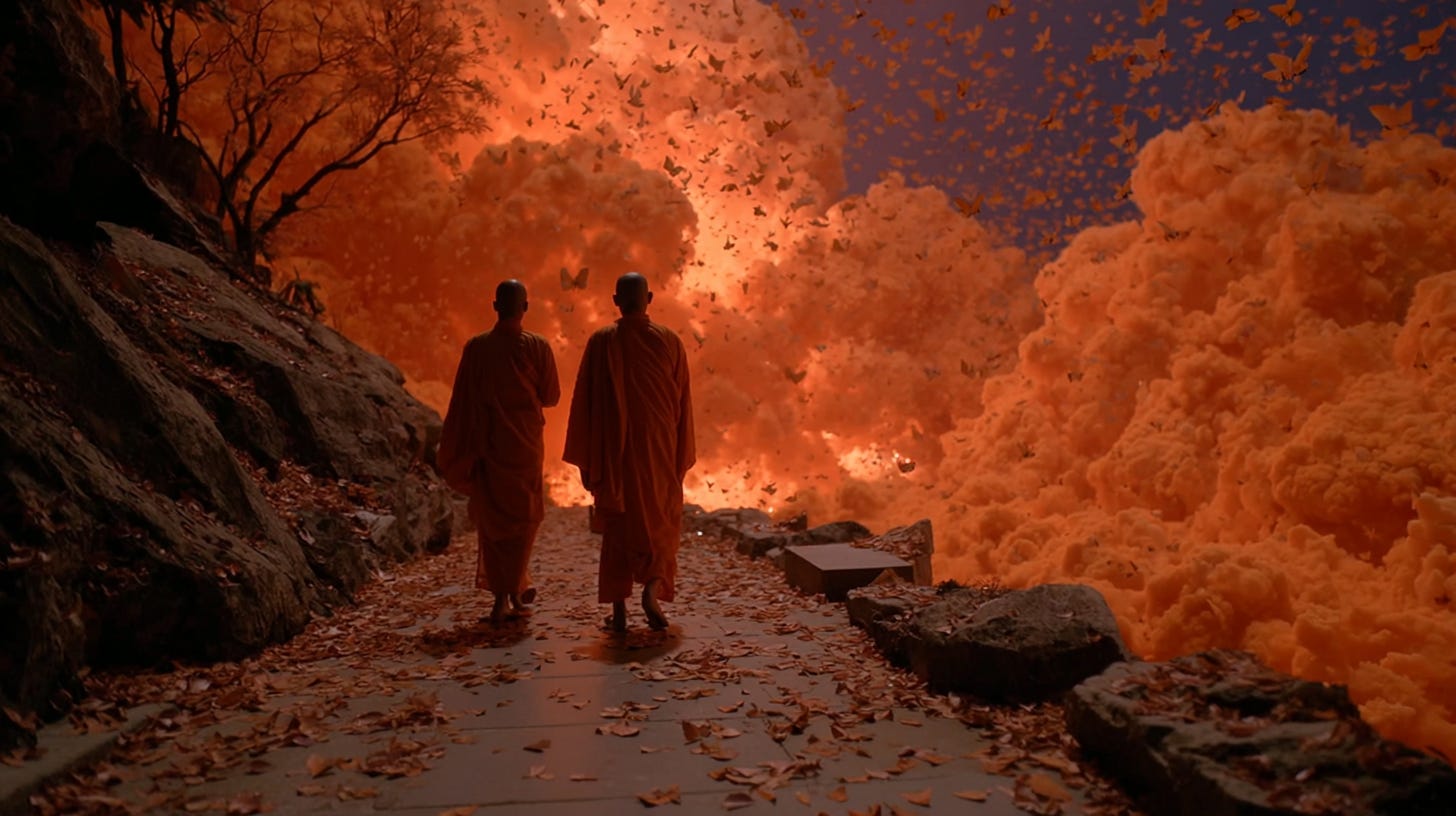
Across cultures, orange often appears where transformation is public and undeniable. In the Buddhist world, saffron and ochre robes became associated with renunciation, humility, and compassion. Tradition holds that the Buddha took up the robe associated with those cast out or condemned, turning a mark of dispossession into a sign of spiritual commitment. The robe’s color is not incidental. Orange is visible. It cannot hide. It announces a life that has stepped away from ordinary social ambition and into a disciplined path of awakening. In that sense, orange becomes the color of chosen exposure. One is seen, and one accepts being seen.
Yet the same visibility that sanctifies can also stigmatize. The modern prison jumpsuit uses orange for nearly the opposite reason: not to signify liberation from the world, but control within it. Orange here marks the body as monitored, separated, and unable to disappear into the crowd. The color warns, identifies, and contains. This doubleness is archetypal. Orange can be the sign of one who has freely entered a vow, or one forcibly placed under judgment. In both cases, however, the color signals a condition in which the ordinary persona has been stripped away. Something rawer is exposed. One stands in a place of consequence.
Nature employs orange with similar ambiguity. The monarch butterfly’s orange-and-black wings are beautiful, but their beauty is also a declaration: approach with care. This is not a harmless softness; it is a coded message of toxicity and defense. The same color that draws the eye also sets a limit. Orange therefore belongs to an ancient language of survival. It says: life is vivid, but not always safe to consume. In animal signaling, as in ritual dress, orange often appears when visibility protects.
This brings us to one of orange’s deepest symbolic meanings: it is the color of intensified life that must be handled carefully. Ripened fruit can nourish, but it can also spoil. Fire gives warmth, but it also destroys form. Autumn foliage is splendid precisely because it announces decline. Orange is lovely in a way that rarely remains still. It carries a sense of time moving through matter.
That temporal quality appears in marriage symbolism as well. The Roman bride wore the flammeum, the flame-colored veil associated with Aurora, goddess of dawn. Here orange belongs to the threshold between one life and another. A wedding is often imagined as a joyful entrance, but it is also a controlled burning of identity. The old life is not simply added onto; it is altered. The veil of dawn suggests that marriage is less a static contract than a sunrise condition, a change in light by which all familiar forms are seen differently. Orange, then, is the hue of passage into fertility, mutual obligation, and the unpredictability of shared destiny.
The mythic orange offered by Jupiter to Juno amplifies this theme. The fruit is round, seeded, fecund. It gathers solar symbolism into a vessel of abundance. To offer an orange at a wedding is to offer a condensed cosmos of generative life: sweetness contained in rind, seed hidden within flesh, fullness ready to divide and multiply. Orange becomes not merely a color but a shape of blessing, a promise that heat, time, and union can produce renewal.
Alchemy recognized this as well. Sendivogius saw in the sun-ripened orange an emblem of transformative heat, the psychic fire that matures substance until spirit may emerge. This is a key to the archetype. Orange is not the first spark, nor the final perfection. It is the stage in which heating has become fruitful. It suggests a vessel under pressure, a substance concentrated enough to release something living from within it. In psychological terms, orange corresponds to those seasons when the soul is worked upon by desire, crisis, longing, discipline, or grief until a hidden vitality begins to form. Not all transformation is gentle. Orange knows that.
For that reason, orange also belongs to catastrophe. Forest fire, volcanic eruption, industrial flare, nuclear blast: these are orange events in which energy exceeds containment. Here the archetype shows its most fearsome face. The same heat that ripens can incinerate. The same light that reveals can blind. Orange reminds us that nature and psyche do not transform only by gradual growth; they also change by sudden combustion. Lives are altered in an instant. Civilizations mark disaster with fiery imagery because the color itself conveys the terrible beauty of irreversible change.
In astrology, this spectrum of meanings can be read through several planetary and house correspondences within a Hellenistic whole sign framework. Orange has no single planetary ruler in the strict traditional sense, but as an archetypal field it resonates strongly with the interplay of the Sun, Mars, and Jupiter, with important contributions from Venus and Saturn depending on context.
The Sun is central. Orange is the color of solar transition: dawn, late afternoon, sunset, autumn light. It reflects not the white blaze of noon, but the Sun as felt through atmosphere, season, and embodiment. The Sun in astrology signifies life force, visibility, purpose, rank, coherence, and the animating center. Orange carries that solar vitality in a human register. It is the Sun filtered through earthly conditions, which is why it can suggest ripeness and worldly glory as much as spiritual illumination. When the Sun is prominent in a nativity or transit, especially when connected with Mars or Jupiter, one often sees periods of intensified visibility, confidence, and creative heat. These are orange seasons of life.
Mars contributes the element of heat, danger, incision, and emergency. Without Mars, orange might remain merely cheerful. With Mars, it becomes urgent, fevered, and edged with risk. The prison uniform, the hazard sign, the wildfire, the volcanic plume, the body under stress: these belong to the Martian side of orange. Mars heats and cuts. It forces action. In the psyche, orange can therefore indicate the phase where desire has become undeniable, where the blood is up, where instinct presses against restraint. It is not surprising that orange sits near red in the spectrum. It carries the body’s insistence, though lifted into broader visibility by yellow’s clarity.
Jupiter enters where orange turns toward fecundity, ceremonial blessing, generosity, and fullness. The wedding fruit, the harvest field, the glowing abundance of autumn, the image of largeness and benevolent increase all carry Jovian overtones. Jupiter expands what it touches. In orange, that expansion becomes warm, expressive, and communal. It is the bounty of life reaching maturity. Jupiter also helps explain orange’s link with magnanimity in sacred contexts, as in robes that signal both renunciation and compassion. What is relinquished is not life itself, but a narrow claim on it.
Venus appears where orange softens into pleasure, attraction, and relational warmth. The fruit, the bridal veil, the evening light on skin, the hearth, shared food, seasonal festivity: these are Venusian inflections of orange. Yet this is not pastel Venus. It is Venus touched by solar heat and Martian intensity, desire becoming visible and embodied.
Saturn may seem an unlikely participant, but it matters greatly. Orange can mark limits, punishment, detention, and the hard lesson of exposure. Saturn governs boundaries, consequence, exclusion, and endurance. The inmate’s uniform and the monk’s robe both bear Saturnian traces, though in different moral registers. In one case, the limit is imposed. In the other, it is chosen. Orange becomes the color of a life under discipline.
By house, the 1st house resonates with orange as visible identity. What is worn on the body, what announces a person immediately, what cannot be hidden from the world: all of this belongs to the 1st. Orange is often social visibility intensified. One enters a room in orange and becomes legible at once. The Ascendant, as the place of emergence into embodied life, has a dawn quality that suits orange especially well.
The 5th house speaks to orange as fertility, pleasure, creativity, and the radiant risk of self-expression. Weddings, children, desire, celebration, artistic flourishing, and games of attraction all gather here. The seeded fruit of Juno and Jupiter belongs naturally to the 5th, as does the ripening of forms that seek continuation through love, art, or offspring.
The 6th house also has a claim on orange through labor, discipline, service, and bodily conditions that require regimen. Monastic life, uniforms, controlled routines, and the visible marks of social obligation can all be read here. When orange appears as warning or managed risk, the 6th house becomes relevant: fires to contain, hazards to navigate, bodies to protect.
The 8th house speaks to orange in its more volatile and transformative aspect. This is the house of mortality, irrevocable exchange, and psychological confrontation with what exceeds personal control. The orange of eruption, trauma, inheritance of consequence, and transformative ordeal belongs here. Orange does not equal the 8th in a simple way, but it can signal the heated process through which one’s relation to loss, power, and surrender is altered.
The 9th house holds orange as sacred vision, religious robes, pilgrimage, doctrine embodied through custom, and the widening of consciousness through discipline. Saffron robes fit especially well here. The 9th is not abstract belief alone; it is the visible ordering of life around what one takes to be ultimate. Orange in this house becomes devotion made public.
The 10th house adds themes of status, public role, and ceremonial distinction. Gold-leaning orange, the hue of dignity, success, honorable maturity, and social recognition, belongs here. The perfected fruit displayed at harvest festival, the honored elder in autumnal robes, the visible culmination of long labor: all of these show orange at the summit.
Lunar cycles also echo the archetype. The russet or autumnal moon evokes times when emotion and memory are suffused with ripening and release. The waxing Moon can resemble orange when desire and form are building toward fullness. The waning Moon may take on orange symbolism in seasons of gathering, when life is being drawn back inward after abundance. Eclipses, too, belong to orange’s dramatic theater, for they alter light in ways that make the sky uncanny, reminding us that illumination itself is subject to interruption and change.
Transits involving the Sun, Mars, and Jupiter often produce orange conditions in lived experience. Sun-Mars periods can bring heat, urgency, exposure, courage, and conflict. Sun-Jupiter periods can bring celebration, fertility, confidence, or public blessing. Mars-Jupiter combinations can intensify action and appetite, for good or ill. When Saturn enters the picture, orange may manifest through disciplined renunciation, public consequence, or the sober dignity that comes from enduring trial. When Venus joins these dynamics, orange becomes relational, erotic, artistic, and festive.
What makes orange so compelling across both culture and astrology is that it links visible beauty with process. Blue can suggest distance. Green can suggest continuity. White can suggest ideality. Orange rarely suggests stasis. It almost always implies that something is changing its state: fruit sweetening, leaves turning, metal heating, vows being made, warnings being issued, day becoming night, passion becoming form.
This is why orange serves so well as a bridge between mythic image and astrological pattern. In culture, it appears where human beings ritualize transition: in marriage, renunciation, sacrifice, punishment, harvest, seasonal celebration, and disaster imagery. In astrology, it appears symbolically wherever vitality is intensified by heat, where identity is made visible, where fertility and consequence meet, and where life passes through combustion toward a new shape.
Astrology acts here as a cosmic mirror. It shows that the same forces seen in ritual color symbolism also move through time, character, and fate. There are orange moments in a life when one is ripened by pressure, made visible by circumstance, or forced to relinquish what can no longer remain unchanged. There are orange chapters when desire becomes creative, when suffering becomes service, when humiliation becomes humility, when the heat of ordeal releases an unsuspected seed of meaning.
To understand orange as an archetype is to recognize that not all warmth is comfort, and not all danger is negation. Sometimes the soul must glow before it can mature. Sometimes what marks us publicly is also what begins our transformation. Sometimes the warning color is also the sacred color. Sometimes the fire that terrifies is the same fire that reveals what was latent all along.
Orange remains timeless because human life is full of these charged intervals. We ripen. We burn. We are blessed and branded. We stand at dawns we did not expect. We wear colors chosen for us, and colors we choose in answer to a calling. We move between blood and gold, appetite and consecration, peril and radiance.
Seen through astrology, orange offers a guide to self-awareness. It asks: where is life heating you now? Where are you becoming more visible than you intended? Where are desire, discipline, or crisis refining your nature? Where is abundance nearing harvest, and where is excess nearing flame? To live consciously with orange is to respect timing, intensity, and the mystery of maturation. It is to understand that transformation often comes not in silence, but in brightness.
And so orange stands before us as a color of living change: the robe, the veil, the fruit, the warning sign, the autumn branch, the burning horizon. It is the psyche under sunlight and strain. It is what glows when life has entered the crucible and has not yet emerged unchanged.