


In the ceramics studio at UH Mānoa, at some point in your undergraduate career, someone asks the question. It might come from a professor during a critique. It might come at the wheel, late in the semester, when you’re looking at a finished piece and not sure what you’ve made. But it comes.
What is art? What is craft? And what is the difference between them?
Nobody answers it. That’s the point. The question isn’t a quiz with a key in the back of the syllabus — it’s a condition you learn to work inside. I got my BFA in ceramics from the University of Hawaiʻi at Mānoa, and I got a minor in graphic design alongside it. Those two disciplines handed me the same unanswerable question from two different directions, and I’ve been carrying both versions ever since.
I keep thinking about this every time someone online declares that AI either is or isn’t art. I want to tell them: you are in a very old argument, and art school did not resolve it, and neither will you.
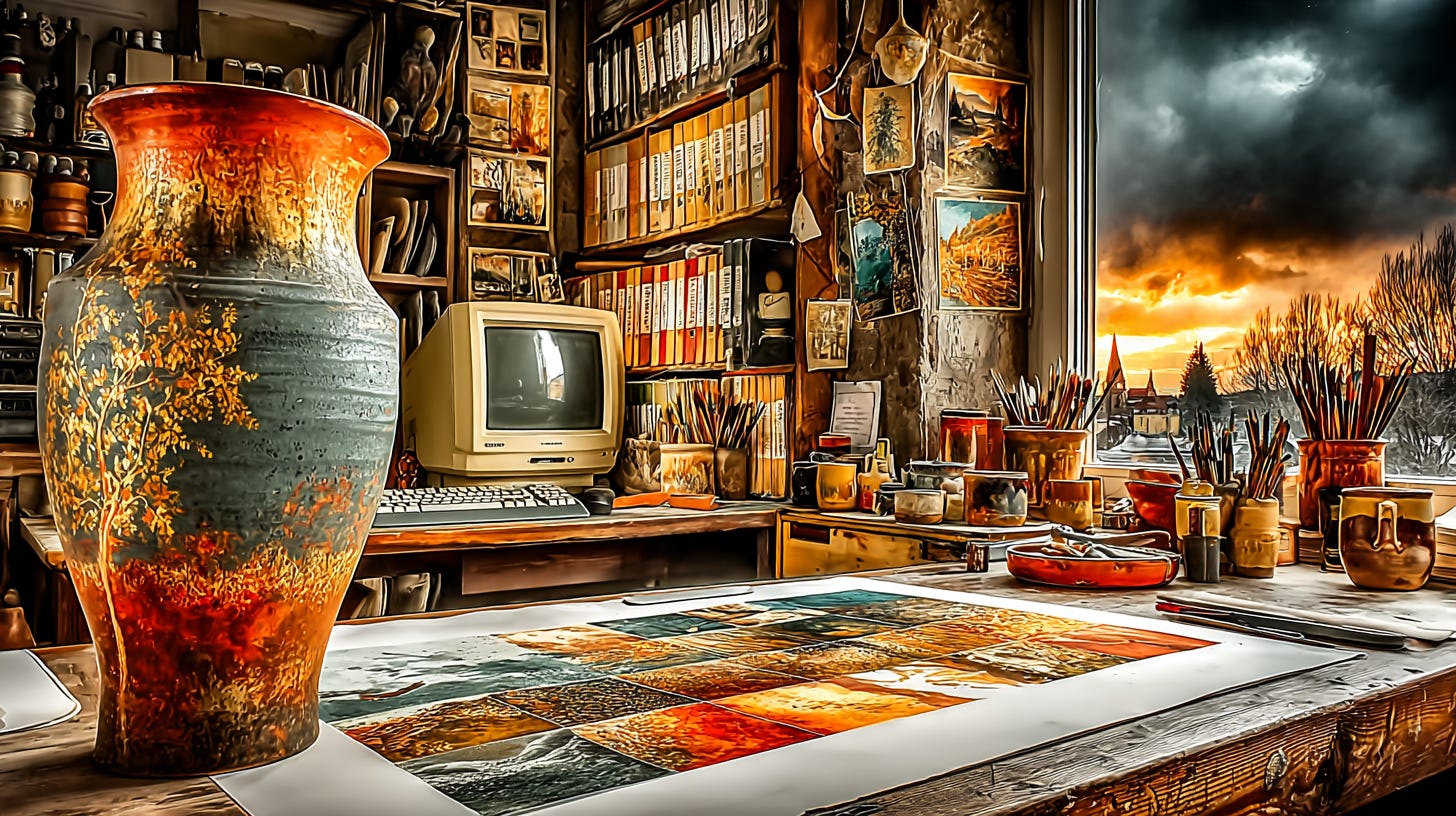
The Etymology Problem
Here is a fact that upends things quickly: art and craft started out meaning the same thing.
“Art” comes from the Latin ars. “Craft” comes from the Old English and Germanic kraft. They arrived in English from different directions, traveling different roads, and when they landed they were assigned different territory — but both words, at their roots, point to the same thing: skill. The ability to do something with your hands and your mind, developed through practice, until the doing has quality.
English split them anyway. Over centuries, “craft” stayed close to the physical and the made, while “art” drifted toward something harder to name — intention, meaning, the thing above the object. But the shared origin doesn’t disappear. When you argue about whether something is art or craft, you’re arguing about a distinction that the languages themselves are not entirely sure they believe in.
This is not a philosophical parlor game. It matters in practice. Because when you’re in a critique and someone says your work is “well-crafted,” that’s a compliment — but it isn’t the same compliment as “this is art.” Most people in a room can agree on craft. Art is where agreement breaks down.
The Question From the Other Direction
The graphic design minor ran me straight into the same problem from a different angle.
When I was studying design, computers were arriving — but not all the way. People still did layups by hand, captured layouts on film, and ran them through chemical processes. QuarkXPress was on the scene — as I recall it — and it was already controversial. The controversy wasn’t really about software preference. It was about whether the software was making us designers or operators — a distinction nobody in the department could fully settle, and I’m not sure we tried very hard.
The question the department was wrestling with, out loud: if you’re building your layout in QuarkXPress, are you making art?
And under that, a sharper version: graphic design has always been built from other people’s material. Photographers take the pictures. Type designers make the fonts. The graphic designer takes all of that, arranges it, and calls the result their work. Is that art, or isn’t it?
Graphic design, in other words, had been in the appropriation business long before appropriation became a hot-button word in the art world. A good layout required the designer to select, arrange, and make purposeful something that began as someone else’s creation. The craft was in the arrangement; the skill was real; the question of whether any of it was art remained, in my experience, genuinely open.
The teachers didn’t close it. They didn’t try to. What they offered instead was something more useful: a vocabulary.
What Aura Does to the Question
One of my professors — Andrea Feeser — introduced a concept that changed the shape of the argument for me.
She brought in Walter Benjamin’s idea of aura: the perception of an object that exists above and beyond the object itself. Not what the thing is made of, not how skillfully it was made. Something felt — the sense of presence, history, and meaning that accumulates around a work and makes people care about it in ways that exceed its material qualities.
A Rembrandt, she pointed out, is paint on canvas or fiber. The craft is real — the technique is sophisticated, the composition deliberate. But that doesn’t explain why people stand in front of it differently than they stand in front of a student copy made with equal technical skill. The difference is aura. It’s the history, the story, the weight of what has gathered around the object over time.
Crucially, she made clear that authenticity is one possible source of aura, but not the only one. Something can be fabricated, knowingly counterfeit — and still generate genuine aura. The aura comes from what people project onto the object, what narrative has been built around it, what it means to its audience in the moment of encounter. She described it once as being “authentically inauthentic”: a thing can be known to be a fiction and still command a real response.
That landed hard. Because once you accept it, craft and aura stop being the same thing, and art becomes the contested space where they sometimes meet.
Some things have craft and no aura. Some things, surprisingly, have aura and almost no demonstrable craft. Those two categories stay with you — and they make you suspicious of anyone who wants to collapse the three terms into one tidy hierarchy.
The question isn’t resolved by this framework. It gets sharper.
Why This Is Still the Right Question
The current argument about AI and art is recognizably the same argument, just with a new tool at the center.
The anxiety is legible: if a person can generate something that looks like a painting, sounds like music, or reads like prose without developing the traditional skills behind those outputs, are they making art? Are they practicing craft? Or are they doing something that has no name yet?
These feel like new questions. They are not. Photography raised them. Desktop publishing raised them. Photoshop got its own version, which was loud and unresolved for years.
What changes each time is the tool. What doesn’t change is the structure of the argument: this new process doesn’t count as real making, because it bypasses the old skill. And underneath that: skill is what separates art from not-art. But we’ve already seen that art and craft share an etymology, that skill alone doesn’t generate aura, and that aura can travel to unexpected places — including places the tools never touched.
The thing art school teaches you, in the end, is not where the line is. It’s that the line is contested, that the contest is serious, and that living inside the question is not the same as being confused. It’s what working artists do.
Appropriation was already the grammar of graphic design before it became a legal and ethical flashpoint. Quark-era designers were already making things that some people in the same department would not call art, while producing work that had real craft and, sometimes, genuine aura. Nobody won that argument. The work got made anyway, which is probably the part that matters.
I don’t know exactly where AI-assisted writing or image-making lands in the art/craft/aura triad. Neither does anyone else, despite the confidence on display in comment sections. What I do know is that craft is possible — it requires the human to refuse the default outputs, to fight the tool’s tendency toward its own patterns, to use the thing with intention rather than convenience. And I know that aura is a separate problem, one the tool cannot solve at all.