


Astrology doesn’t work because work, and whether something works or doesn’t work, whether it’s functional or dysfunctional, are entirely human concepts. It’s really humans that are doing the work.
Rather, I would say that being human is archetypal. And one of the key archetypes of being human is continual astonishment at the serendipity of the similarity of our perception of the collective human experience, and how correlation of phenomena is continuous across domains of existence.
Let me break that down, because it’s carrying a lot in one sentence.
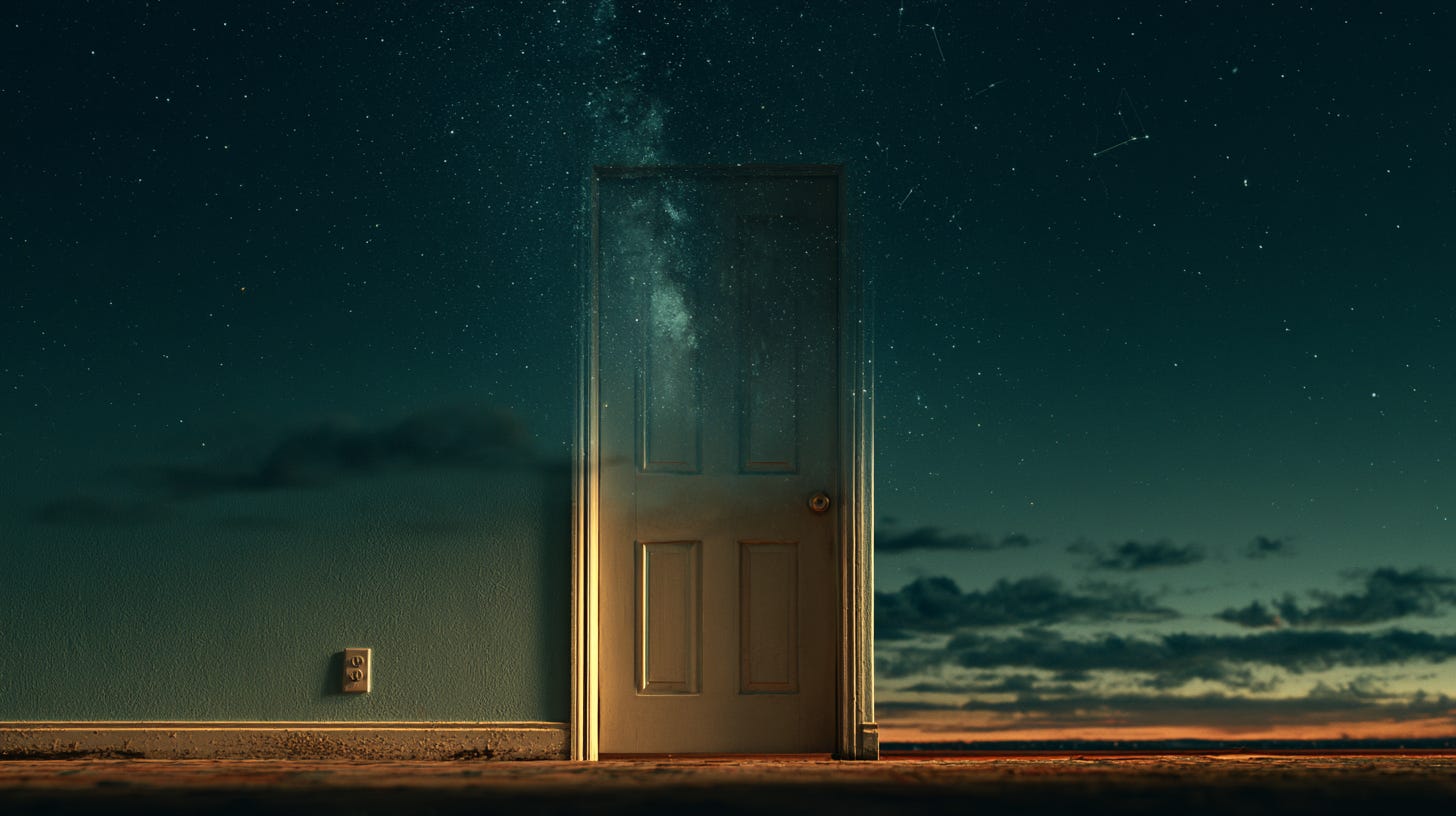
Archetypal means the shape of a human life isn’t original. We’d all like to think our experience belongs to us specifically. But the categories are old, and there aren’t that many of them. Birth, work, sickness, partnership, and death. Everybody gets a version of the same short list, and the versions rhyme.
Then the astonishment. Not astonishment once, early on, and then you settle into knowing how things are. Continual astonishment. It keeps arriving. You tell somebody the most private thing you have ever felt, the thing you were sure was yours alone, and they say, yeah, me too. And something goes off in you like a bell. That’s the serendipity part. Not that we’re similar. That the similarity keeps showing up as a surprise, over and over, like it’s news.
And the last piece, which is the one I actually care about. Correlation of phenomena is continuous across domains of existence. What I mean is that the patterns don’t stop at the edge of one domain and start fresh in the next. The same shapes turn up in a body, in weather, in a marriage, in a market. I’m not saying one is causing the other. Correlation isn’t causation and I don’t need it to be. I’m saying the continuity is there, and it’s available to be noticed.
It is part of the human experience to attempt to explain the magical nature of the universe itself. And in that process, there are some who collapse that magic down into something that is fundamentally common, base and mundane. We might call this materialism, in the sense that we are asserting that all phenomenon is explicitly material, and there is nothing other than the material that we can see. The opposite of that might be somebody who constantly asserts that there is only magic in the world, and that all things are magical and mystical, and that there is nothing mundane, base or common.
Notice what both of those moves do to the domains. If there is only the material, then there aren’t seperate domains to correlate across, and the continuity I’m describing isn’t wrong so much as it has nowhere to happen. And the person who says everything is magic has done the same thing from the other end. One domain again. Just a prettier one.
For most of us it’s somewhere in between. We live in this world where things are pretty mundane and basic. Even things as wierd as atomic particles and quantum entanglement are basically normal. And even though those concepts were magical to begin with, disseminating those ideas into popular thought makes them common. One of the side effects of the “scientific mind” is the mundanifying, or the commonifying, of things that are magical.
And then the flip side: religion or spirituality takes things that are fundamentally mundane, like fire and wind and water, and turns them into elemental magic.
But really, we go through our lives, living, working, going to the grocery store, nearly missing the pedestrian in the crosswalk and at the same time getting rear-ended by a car. Or we have to deal with sickness and disease and cancer, having a stroke or a heart attack, or high cholesteral. And so we have all these components of life, represented in the 12 houses of astrology, that are fundamentally mundane, normal and absolute. Absolutely, like, just blah, in a way.
And this is where the archetypal thing stops being an abstraction. Twelve houses. Somebody sorted the whole of ordinary life into twelve categories a very long time ago, before any of us got here, and you can still read the list and find your own week in it. That’s the serendipity of the similarity, sitting there in a table.
And yet the 12 signs of the zodiac represent the opposite side of that: the magical, the mystical, the absolute. The things that are celestial in nature that we can’t ever truly understand, except that the terrestrial houses are continuously connected to the celestial palaces. That’s the continuity, right there in the structure of the thing. The houses are one domain and the palaces are another, and the correlation runs between them without a break. And it’s that. It’s that exploration of the mundane, in connection with the divine. With the magical. It’s how we understand this serendipitously correlative experience of phenomena.
There are a lot of different systems of mystical thought and divination, astrology is often considered the “highest” of those forms, because of its comprehensive, systematic infrastructure. Which is why the infrastructure is the part worth pointing at. If you want to notice a pattern that runs across domains, it helps to have a system with enough joints in it to hold the comparison still. It’s less a mechanism then a rhyme, and a rhyme needs a form to be heard in.
And so I don’t think it’s so much about that. Of course, there’s always going to be people who try to materialize the mystical, and there’s always going to be people who try to mysticalize the material. I think one of the beauties of astrology is that when you get right down to it, there is this ability to leave the mystical mystical and the mundane mundane. Rather than trying to transform one into the other, you understand how the gap between the two is constantly bridged by our own human experience.
The planets aren’t doing it to you. Nothing is being transmitted. The correlation is what’s continuous, and you’re the one standing there noticing it, which is where we started. It’s really humans that are doing the work.