


NB: I base my archetype in focus articles on the ARAS archetypes that are highlighted each month. You can find ARAS on Patreon.
Few images in the ancient world carry as much charge as a single, fixed stare. Homer’s description of the Gorgon’s head mounted on Athena’s shield—”a thing of fear and horror”—names something that recurs across nearly every culture that has left a written record: the belief that a look, delivered with sufficient malice, can wound, sicken, or kill. This is the Evil Eye, and it is worth taking seriously not as folklore to be outgrown but as a durable psychological and symbolic pattern. Jane Harrison’s observation that the Gorgon “was regarded as a sort of incarnate Evil Eye” points to something important: the myth did not invent the fear, it gave the fear a face.
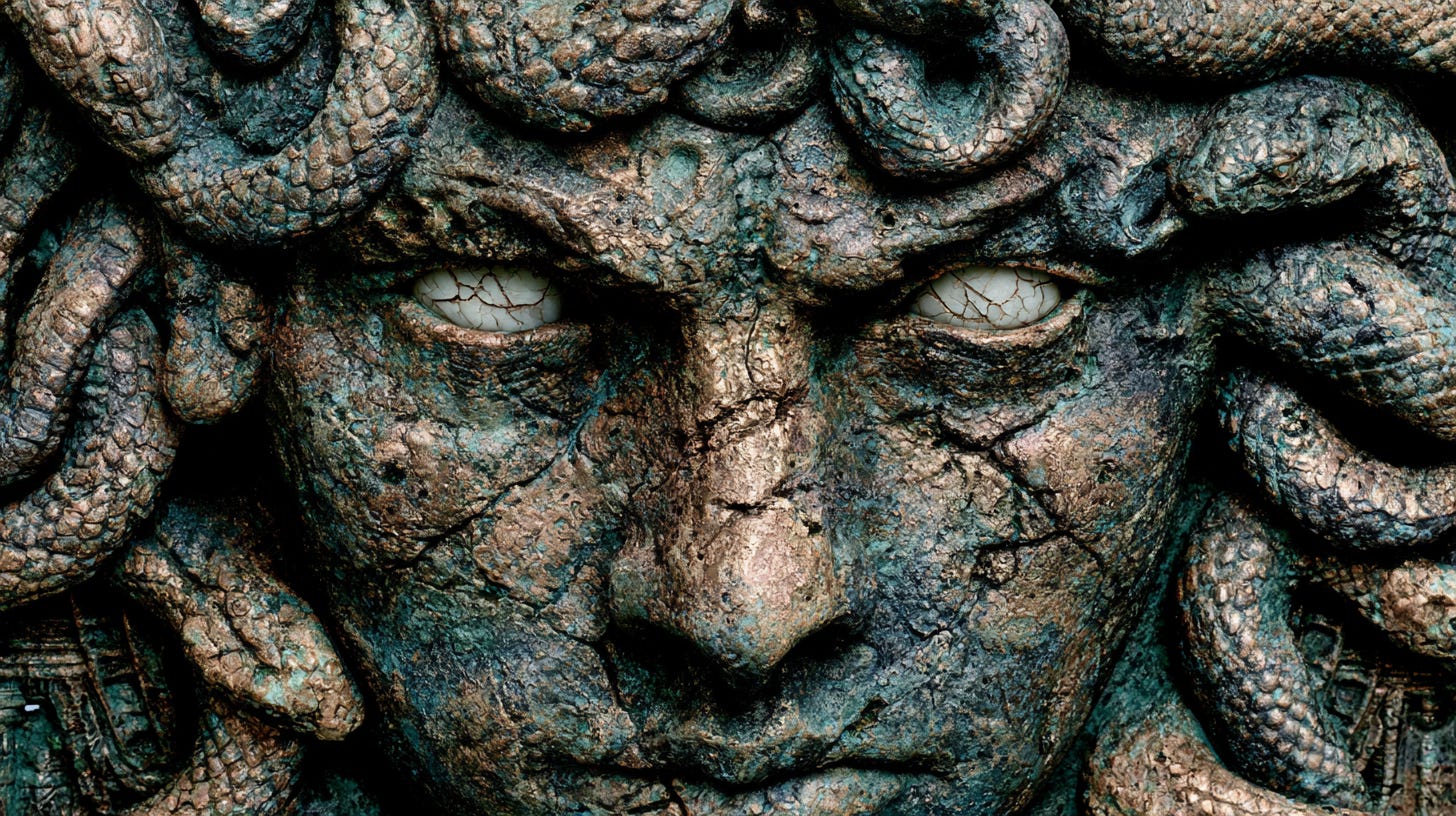
What makes the Evil Eye archetype distinct from other forms of malevolence in myth is its precision. It is not violence in general, not curse in general—it is harm transmitted specifically through vision, through the act of being looked at. An Arab proverb captures the stakes bluntly: the Evil Eye “empties houses and fills tombs.” The one-eyed Irish figure Balor could kill with a glance. A Libyan basilisk, so the legend goes, could not survive its own reflection. Across these traditions the mechanism stays constant even when the mythic dressing changes: seeing is not passive. To look, in this framework, is to act on what is seen, and to be looked at is to be exposed to a force that can diminish or destroy.
This essay explores that pattern first through its cultural and symbolic history, then through the language of astrology, where a comparable logic of envy, exposure, and hidden hostility has its own long tradition. Both frameworks converge on the same insight, arrived at independently: envy is not merely a feeling contained within the person who feels it. It moves. It has a vector. And whether we call that vector a Gorgon’s stare or a badly aspected planet, the archetype asks us to take seriously the idea that attention itself can carry weight.
Cultural and symbolic exploration
The belief in a harmful gaze is genuinely old and genuinely widespread, appearing independently among Indo-European, Semitic, and Mediterranean peoples long before any of these cultures had sustained contact with one another. This independence is part of what makes the pattern worth studying closely: it did not spread from a single source and get retold with local color. It seems, instead, to have arisen wherever humans lived closely enough together that envy, scarcity, and visible good fortune created social friction.
One plausible origin, suggested in the source material, traces the Gorgon image back to something more practical than myth: early hunters displaying the severed head of a slain animal as a trophy, or the deliberately terrifying masks worn by shamans in ritual context. In both cases the purpose is the same—to project a face so fearsome that it stops an aggressor before contact is made. The Gorgon, with her writhing serpent hair, tusks, and protruding tongue, may be a mythologized memory of that older, cruder technology of deterrence: make your face so awful that no one dares approach.
But the Evil Eye proper is a step beyond simple fearsomeness. It is not about looking frightening; it is about the eye as a weapon in itself, independent of the rest of the face. This distinction matters. A Gorgon’s severed head could theoretically be avoided by looking away from her whole visage. The Evil Eye tradition insists that it is specifically the eye—the organ of perception—that carries the lethal charge, which is why so many protective customs across cultures focus on the eye directly: painted eyes on boats and doorways, blue glass amulets shaped like eyes, charms meant to meet and absorb a hostile gaze before it reaches its target.
The Balor legend from Irish tradition offers a variation worth sitting with. Balor’s single destructive eye was said to require several men to lift its lid, as though the eye itself had grown heavy with the accumulated weight of what it could do. This detail suggests that the Evil Eye is not always spontaneous or involuntary. Sometimes it is understood as a power that must be managed, restrained, kept mostly closed, because its user recognizes its danger even to bystanders. That is a notably mature piece of folklore: it builds in the idea that the possessor of a dangerous gift bears some responsibility for containing it.
The Libyan basilisk, unable to survive its own reflection, adds a further layer. If the Evil Eye is lethal to whatever it looks at, then a being whose entire nature is Evil Eye becomes lethal even to itself once the gaze turns inward. This is myth doing something psychologically precise: it encodes the idea that a force built entirely out of destructive projection cannot survive self-examination. Turn the same eye on itself, and it dies. There is a lesson embedded here about the fate of pure envy when it runs out of external targets.
This is where the source material’s invocation of psychological projection becomes useful rather than merely explanatory. Projection, in its clinical sense, is the unconscious expulsion of some disowned piece of the self onto another person, who then seems to carry a menace that actually originates internally. At its most destructive, projection behaves exactly like the Evil Eye as myth describes it: it creates a field of hostility between the person doing the projecting and the person receiving it, a field that both parties may sense even without being able to name its source. The myth externalizes what the psychology internalizes. Both agree that the transmission is real, even if its true origin is disputed.
And at the center of both the myth and the psychology sits envy. The Evil Eye is, in nearly every tradition that names it, specifically the eye of envy—not random malice, but malice provoked by seeing something desirable in another: beauty, wealth, health, a new child, good fortune of any kind. This is why so many protective customs in Evil Eye cultures are triggered by praise. A compliment, in these traditions, is dangerous precisely because it draws attention to the thing worth envying. Mortals and immortals alike are shown as subject to this dynamic in myth, which suggests something the source material states directly: envy is not a moral failing confined to the wicked. It is a structural feature of consciousness itself, capable of arising in anyone who sees something they lack in someone who has it. The Evil Eye, understood this way, is less a villain’s tool and more a shadow function of vision—the dark twin of admiration.
Astrological framework
Astrology, working from an entirely different set of premises, arrives at a strikingly similar picture of hidden hostility, envy, and the danger of exposure. Using a Hellenistic whole-sign framework, several placements map onto the Evil Eye’s core themes: concealment, malefic influence, the vulnerability created by visibility, and the specific wound of envy.
Begin with the traditional malefics, Mars and Saturn. Mars carries the heat of direct aggression—conflict, rivalry, the desire to overpower. Saturn carries something colder and more patient: restriction, denial, the long grinding influence of scarcity and limitation. Where the Evil Eye tradition speaks of a gaze that diminishes its target, astrology has long assigned a similar diminishing function to Saturn in difficult aspect or dignity, and a similar aggressive function to Mars. A chart in which Mars and Saturn combine forces against a placement tied to visibility or vitality—say, the Sun or the Ascendant—describes, in astrological language, something close to what the myth describes: a force that seeks to reduce what is bright by contact with what is hostile.
The houses offer an even more direct correspondence. The twelfth house, in whole-sign practice, governs private or hidden enemies—exactly the register in which the Evil Eye operates, since its harm is rarely delivered face to face. The Evil Eye does not challenge you to a duel; it works from the margins, from someone standing nearby whose ill will you may never confirm. The twelfth house’s traditional association with self-undoing and concealed affliction gives astrology a structural home for this exact anxiety: the fear of an enemy who cannot be identified, whose hostility must be inferred rather than confronted. The seventh house, by contrast, governs open enemies—known rivals, declared opponents. The Evil Eye belongs unambiguously to the twelfth house’s territory, not the seventh’s, which is part of why it produces such a particular kind of dread. An open enemy can be met. A concealed one can only be warded off.
The eighth house adds another layer relevant here: the house of shared resources, but also of the psychological undercurrents that pass between people without full conscious awareness—suspicion, entanglement, the sense of being affected by forces one cannot fully name. Where Evil Eye folklore describes a “noxious field” created between the one who envies and the one who is envied, the eighth house is the astrological address for exactly this kind of field: an exchange that is real, consequential, and largely invisible.
The Sun deserves particular attention, since visibility is the precondition for becoming a target. In Hellenistic technique, a planet described as combust—too close to the Sun’s rays—is weakened by proximity to that brightness rather than strengthened by it, an old paradox worth noting: nearness to what shines can burn as easily as it can illuminate. The Evil Eye tradition encodes a related paradox at the level of lived experience. To be seen, to be praised, to be visibly fortunate, is to become vulnerable in a way the unseen and unremarkable are not. This is precisely why so many cultures developed customs of deflected praise—the reflexive “not too bad” in response to good news, the refusal to overtly admire a healthy child in front of strangers. The instinct being managed here is astrologically coherent: solar visibility invites both admiration and its shadow.
Aspect doctrine contributes one more piece. In the whole-sign framework, certain sign relationships are said to be in a state of aversion—unable to see one another by any classical aspect, and therefore unable to communicate directly. Some interpretive traditions link this “zone of aversion” to influence that must travel indirectly, outside ordinary channels of exchange. This maps with real precision onto the Evil Eye’s operating logic. The envious glance does not arrive through declared channels of conflict; it arrives sideways, through proximity without open relationship, exactly as aversion describes planetary bodies that affect each other’s condition without a formal line of sight between them.
Finally, lunar timing offers a practical dimension long recognized in folk practice, where certain phases of the Moon were considered more favorable than others for protective rites, cleansings, or the making and consecration of amulets. A waning Moon, associated across many traditions with release and the shedding of accumulated negativity, would be a natural period for ritual work aimed at clearing a suspected Evil Eye affliction, while a waxing or full Moon—phases tied to increase and culmination—would suit rites meant to build protective strength before a period of expected exposure, such as before a public celebration or an event likely to draw attention and praise.
Cross-cultural and astrological integration
What emerges when these two frameworks are placed side by side is not coincidence so much as convergent design. Myth and astrology, developed independently and largely without cross-reference, both arrive at a three-part structure for describing envy’s danger: a hidden source of hostility, a visible target whose exposure creates vulnerability, and a channel of transmission that operates outside open, declared conflict.
The Gorgon’s stare and the twelfth house both describe an enemy who cannot be confronted directly. The basilisk’s fatal reflection and Saturn’s cold, self-limiting influence both describe a force that consumes itself once it runs out of external objects. The Arab proverb about emptied houses and filled tombs and the eighth house’s governance of shared, half-conscious psychological currents both describe harm that moves between people along channels neither party fully controls. And the widespread folk practice of deflecting praise finds its structural explanation in the Sun’s paradoxical vulnerability to what stands nearest its own light.
This convergence matters because it suggests the Evil Eye archetype is not merely a superstition that a more rational culture eventually corrects. It is a recurring attempt, made independently by many traditions using many different symbolic vocabularies, to describe something real about how envy behaves in human communities: unevenly distributed goods draw attention, attention draws a mixture of admiration and resentment, and resentment, when it cannot be voiced or resolved directly, tends to seek indirect outlets. Myth gave that process a face and an organ. Astrology gave it houses, planets, and angles of relationship. Depth psychology gave it the word projection. All three are describing the same current from different banks of the same river.
There is also a lived, embodied dimension to this pattern that both frameworks acknowledge without fully resolving: the discomfort of being looked at with mixed feeling, and the reciprocal discomfort of feeling one’s own admiration curdle, without quite choosing to, into something less generous. Anyone who has felt a flicker of envy toward a friend’s good fortune, even while genuinely wishing them well, has some private acquaintance with the archetype from the inside. This is likely why the myth insists that even the gods are not exempt from it. Envy is not confined to villains. It is a structural possibility built into the act of seeing something desirable in someone else, and the Evil Eye tradition, read this way, is less an accusation against particular malicious people than an honest account of a hazard built into social life itself.
The Evil Eye endures across so many unrelated cultures because it names something that has never stopped being true: attention is not neutral, and visibility carries a cost alongside its rewards. Whether encoded in a Gorgon’s severed head, a one-eyed Irish giant, a self-destroying Libyan lizard, or the astrological logic of hidden houses and averse signs, the underlying claim is the same. What shines draws both admiration and its shadow, and the shadow, denied a direct channel, tends to travel sideways.
Understood this way, the archetype offers less a warning to fear other people’s stares and more an invitation to notice one’s own capacity for both admiration and envy, and to hold that capacity with some honesty rather than projecting it entirely outward. The oldest protective customs—the deflected compliment, the amulet, the modest response to good fortune—were never really about controlling other people’s eyes. They were about managing the exposure that comes with being seen at all, a task that remains as relevant now as it was in the world that first imagined a Gorgon’s stare turning flesh to stone.