


The Foundational Polarity
I want to start with something more basic than planets or houses. The foundation of astrology is not a technique, and it is not a table of rulerships. These polarities, the sun and the moon polarity, are actually the origin of astrology. It is the movements of the sun and the moon that define astrology at its most fundamental and basic level. Every dignity, every aspect, every house cusp sits on top of that first fact, and it is easy to forget the fact once you are deep in the tables.
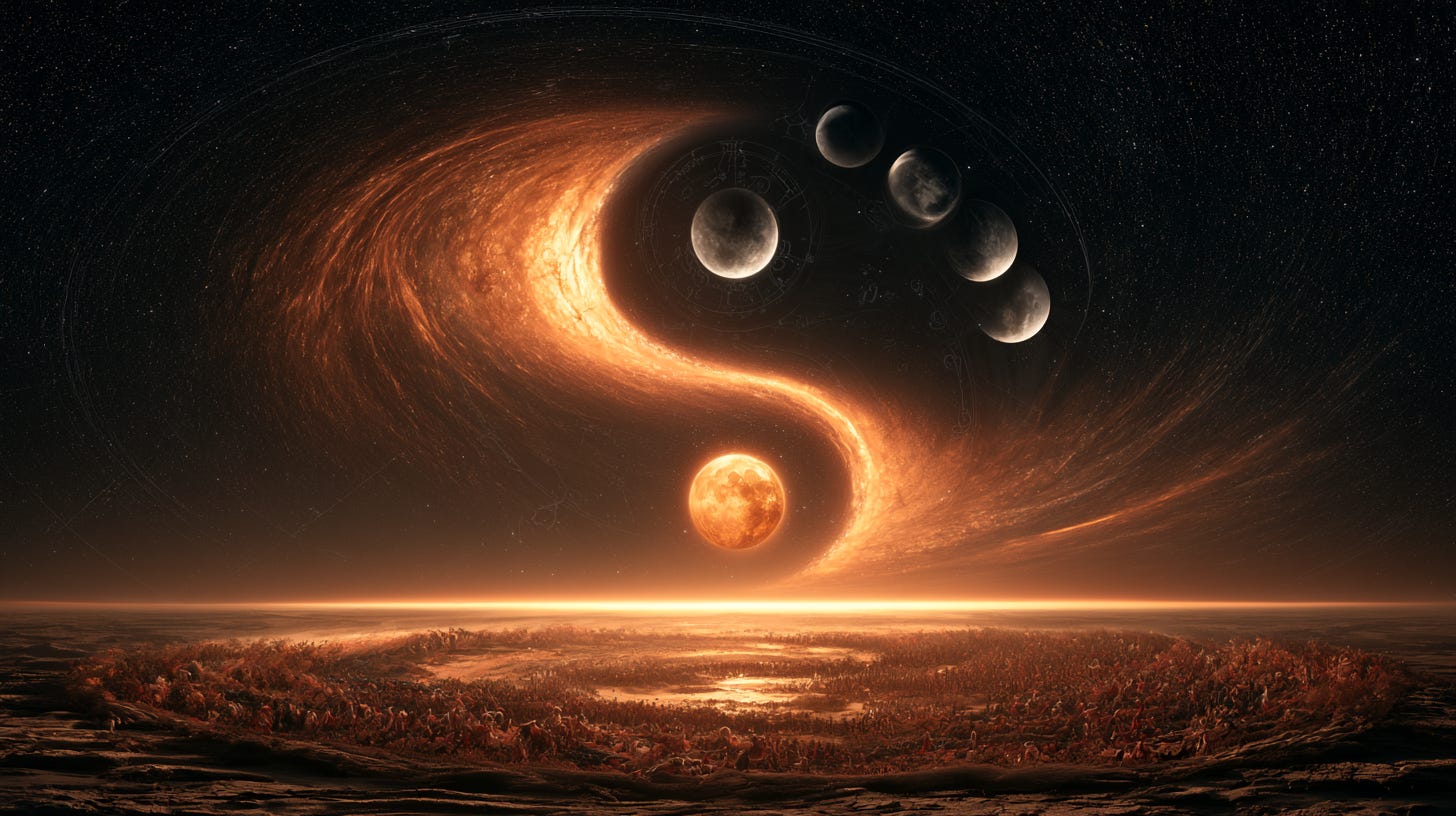
The two bodies do not behave the same way, and the difference is the whole argument. The sun is a single blazing point, fixed in its cycle, holding one place in the sky relative to the earth and moving through the zodiac in one steady repeating line. The moon does the opposite. It waxes, wanes, disappears, returns, and redistributes its light across a cycle that never looks the same twice. Where the sun holds, the moon changes. Where the sun is one thing, the moon is many things in sequence, and it never stops changing shape long enough to be called one thing at all.
At the same time, the dance between the sun and the moon is not exact. The moon’s sidereal period versus its synodic period are offset. They’re not precise, and that imprecision, between 27.3 days and 29.5 days, creates the spiral nature of the zodiac, so that it’s not exactly the same. A closed loop would repeat itself forever, an identical circuit chasing an identical circuit. What we actually have is a spiral. That is not a defect in the math. It is the reason the whole system is alive rather than a wheel turning in place, a living, evolving thing instead of a closed one.
Cosmic Symbolism and Cultural Structures
Carry that polarity into culture and it does not stay abstract for long. The lunar representing diversity, the solar representing singularity. The lunar representing a multiculturalist approach and the solar representing a monoculturalist approach. The solar principle stands for the individual, the patriarchal, singularity, a monoculturalist orientation. The lunar principle stands for the collective, the plural, the redistributive, a multiculturalist orientation. Neither of these is a value judgment. They are descriptions of two different shapes a culture, or a chart, or a mind can take.
The trouble starts when the solar shape stops describing and starts claiming exclusivity. Supremacy of any kind is a monoculture, the belief that only one culture deserves to survive. This can be monotheism, racial supremacy, class supremacy or any other type of ideology that claims rightness over others. Whatever axis it runs along, race, religion, class, the shape is the same: singularity has stopped being one valid orientation among several and started insisting it is the only one that gets to exist.
The same failure shows up outside of ideology, in the ground itself. A field planted in a single strain, and nothing else, can outproduce a mixed field in a good year, and it can collapse in a single bad one, because there is no genetic variation left in the soil to meet whatever the bad year brings. One blight, one pest that happens to favor exactly that strain, one season of unfamiliar weather, and the whole field goes down together, because every plant in it was betting on the identical set of strengths and carrying the identical set of weaknesses. A mixed planting loses some of its crop to the same blight and keeps the rest. An ideological monoculture fails for the identical reason. A system that has erased its own plurality has erased its own resilience along with it, and it looks strongest in the year right before the one that breaks it.
Astrology as a Poly-Philosophical Practice
Astrology inherits this argument as a practice, not only as a metaphor. I was just reading some threads. One person was saying (paraphrased):
What is the one true astrology? I’ve been studying Western astrology, but I hear all this stuff about Vedic astrology, and I want the one true astrology. I don’t want to study astrologies that are fake and false.
This is a monotheistic attitude towards astrology, and astrology is decidedly anti-monotheism. It opposes monotheism. It’s polytheistic, or poly-philosophical, by its very nature.
Vedic and Western are not competing answers to the same test, with one of them destined to be marked wrong. They are different dialects describing the same sky, and a dialect is not a mistake, it is a voice. All these different perspectives can come to a chart, provided that the practitioner establishes their own criteria for themselves. It’s okay to change your criteria over time; you don’t have to feel like you’re stuck, but you’re not going to be able to be effective in the analysis of the chart and the transits unless you have a perspective, unless you have something you’ve decided. That is what a dialect requires of the person speaking it. The techniques are learnable, house by house, sign by sign, aspect by aspect. What can’t be learned out of a book is your own system of understanding, and that is exactly why the sky needs more than one voice describing it rather than fewer. If you understand the core fundamental principles of the house, for the particular house system that you’re using, and the paradigm that you’re approaching things with, you can take your concept of the soul, your concept of evolution, your understanding of the house, and create a synthesis that is coming from your own lived experience. It’s going to be unique to you. My perspective is unique to me. Nobody’s lived the path of my life that I’ve lived except for me. That is the actual argument for plurality, not a courtesy extended to other dialects but a fact about where any single dialect’s authority comes from in the first place. As long as we become familiar with our tools, and we become familiar with our viewpoints and our understanding of those viewpoints, then we can facilitate the conversation that takes place in our readings with our clients, to move toward the intention that we have as a practitioner.
A single birth chart carries the same plurality inside its own borders. Readings are a collaborative expression of the moment of consultation between the people that are doing the readings. Nothing here is only one thing. When we look at a chart, the chart has a Gestalt, and at the same time there’s multiplicity within that gestalt. We can’t say that the gestalt is singular, and yet we can’t deny that the plurality of the chart has a realistic quality to it. A chart is one recognizable whole and several contradictory currents running through that whole at once, and it does not need to resolve the contradiction to be read honestly.
A Holographic, Integrated Cosmos
None of this makes the sun the villain of the story, and it does not make the moon the sole hero either. A chart with only lunar multiplicity and no solar center would never hold together long enough to be read at all, and a chart with only solar singularity and no lunar variation would never change, grow, or survive its own fixed identity for very long. Solar energy provides the center and the continuity, the fixed point everything else gets measured against, the thing you can return to and still recognize. Lunar energy provides the variation and the capacity for renewal, the fire and the seeding both, the reason the fixed point does not calcify into the only point. Neither one is optional, and neither one is the whole cosmos by itself.
That is the holographic point, not a fractal one: singularity holds a seed of multiplicity inside it, and multiplicity holds a seed of singularity inside it, the way the Taijitu draws a small dot of each color inside the body of the other. Even the view I am holding right now, of the sun and the moon and how they share a sky, is itself a lunar thing, subject to the same dance. As our own soul goes through its evolution, our view of soul and our view of evolution will thereby change accordingly. There’s never one right answer that is universally right for everybody, and universally right for the same person forever and ever. The rightness is always in change and in flux, and it’s a dance of listening to the music and moving in accordance with the music of the stars and the music of the spheres, the music of our lives, and dancing with that music, and moving our thoughts and our views and our habits to be in alignment with what the music of life is displaying for us at any point in time. It’s good to establish a view, then work with that view, and then review and reanalyze that view to see if it’s still valid, and then change the view to fit the circumstances of our life that are continuing to unfold for us as our own soul goes through its own evolution.
The true danger was never the solar principle itself. The danger is supremacy, the mistake of letting one principle dominate and forgetting that it must share the sky with change. A sun that remembers the moon is a center that still allows for renewal. A sun that forgets the moon becomes exactly the kind of monoculture the forest burns away.