


NB: I base my archetype in focus articles on the ARAS archetypes that are highlighted each month. You can find ARAS on Patreon.
Robert Frost’s traveler stands in a yellow wood and cannot move. Not because the paths are blocked, but because they are open. Both are possible, and being one traveler, he cannot take them both. The poem isn’t really about the road not taken. It’s about the moment before the taking: the long pause at the intersection, the weight of what cannot be undone, the strange vertigo of a choice that will echo forward into a life not yet lived.
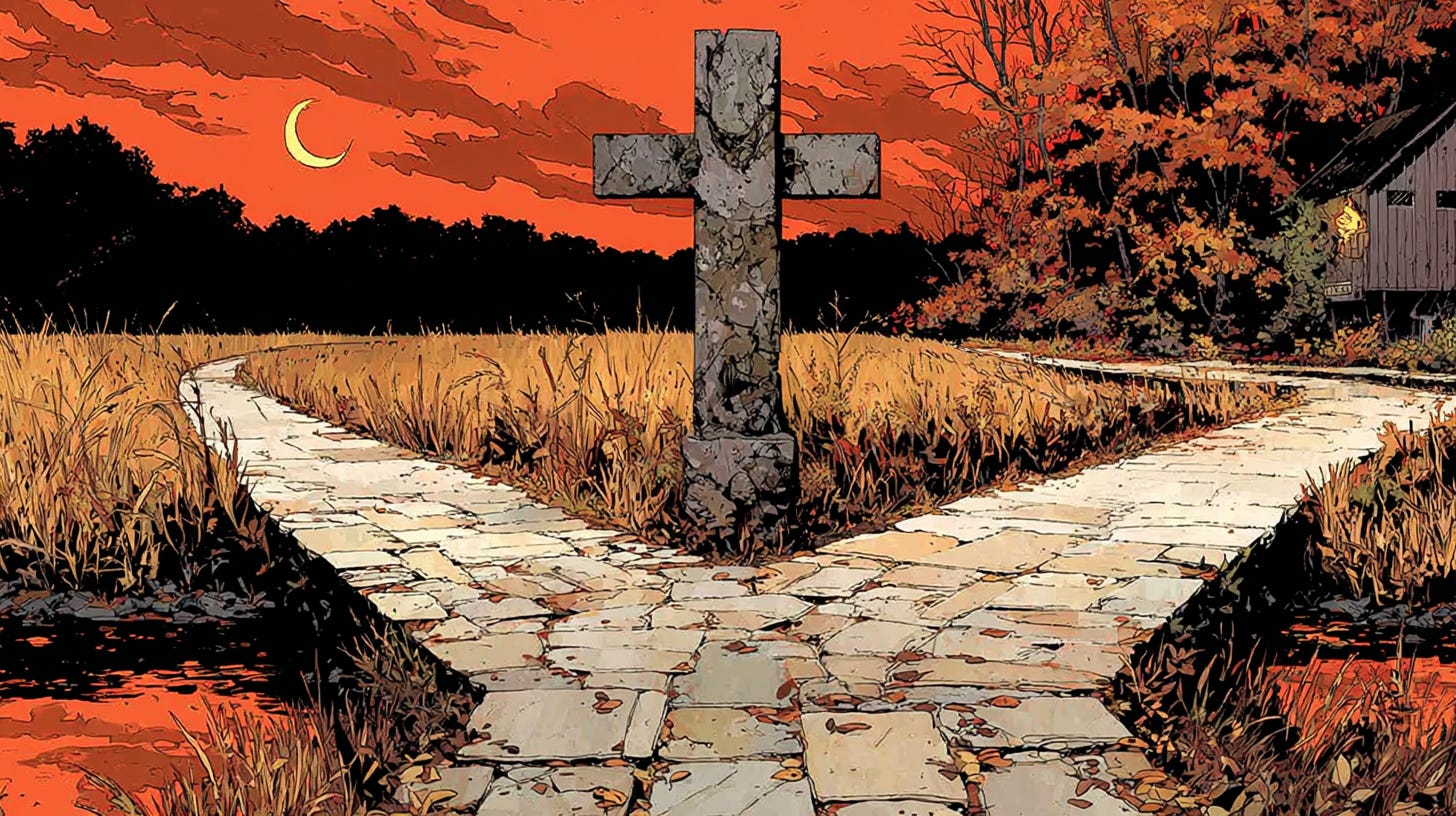
That pause is the crossroads. And it’s one of the oldest sacred geometries in human experience.
The ARAS material frames the crossroads as “a locus of extreme potency able to contain and synthesize opposites flowing into one another.” This is a precise description of what makes the image psychologically inexhaustible. The crossroads is not a place of resolution. It holds contrary possibilities in the same space without collapsing them into a single outcome. To stand at the crossroads is to experience, briefly and acutely, what it feels like when fate is still undecided.
Every culture with roads has consecrated this image, and the reasons aren’t arbitrary. The crossroads is the point where the logic of a single direction breaks down. You cannot go north and south simultaneously. You cannot remain indefinitely at the junction. The geometry of the intersection imposes a demand that ordinary travel does not: you must choose, and the choice will cost you every path you do not take.
Cultural and Symbolic Exploration
The Geometry of Potency
Before the mythology, the geometry. A crossroads is where two or more paths intersect, which means it is the one point on any journey where the traveler must stop being a traveler in the current direction and become something else: a chooser. The road compels forward motion; the crossroads compels deliberation. This enforced pause is why crossroads have been felt as charged, as uncanny, as inhabited by presences that ordinary stretches of road do not possess.
The ARAS material identifies two primary types in the classical world. The three-way junction (triodion in Greek, trivium in Latin, from which we derive “trivial,” originally meaning the common matters discussed where three roads met) and the quadratic crossroads, the four-way intersection. These two configurations carry different symbolic valences. The triodion, with its triangular logic, bends toward the chthonic, the lunar, the realm of Hecate. The quadratic crossroads bends toward the psychopompic, the mercurial, the hermeneutic. Both are sites of transition, both are openings, and both draw the attention of the invisible.
Ancient travelers left offerings at crossroads in recognition of what the ARAS source calls “the invisible agencies that affect life’s transitions.” This is a remarkably clear-eyed acknowledgment embedded in ritual practice: that at moments of genuine transition, something beyond ordinary human agency is operative. The crossroads is the place where individual will intersects with forces that exceed it. To leave an offering there is to admit that you are not entirely the author of what comes next.
Hecate: Mistress of the Triple Way
Of all the divine figures associated with the crossroads, Hecate is the most completely identified with it. In ancient Greece, the junction of three roads was her domain, and the hekataion—a carved pillar bearing three faces looking outward in three directions—marked her presence at these junctions. The three faces are not redundant; they are directional. Hecate looks at once toward all the roads that branch from this point, toward all possible futures simultaneously. She is the only figure who does not have to choose.
Hecate’s dominion extends over what the ARAS material calls “the three realms of the physical world—sea, sky and earth.” She is a goddess of thresholds in the most comprehensive sense: not one boundary but all boundaries, not one transition but the principle of transition itself. She is there at doorways. The ARAS source notes that she arrives at the doorways of those laboring toward birth, a midwife mediating the crossroads between existence and nonexistence. She is there at the crossroads of the roads. She is there at the threshold of the underworld, of which she is mistress.
The underworld connection is crucial. The ARAS material notes that at the crossroads, at Hecate’s junction, the bodies of executed criminals were thrown. This is not merely a sanitation choice. It encodes a cosmological understanding: the crossroads is an opening in the ordinary fabric of the world, a permeable boundary through which what has ended can pass into what lies beyond. To deposit at the crossroads is to place something at the hinge between worlds. In this frame, the crossroads is not merely a geographic junction but an ontological one: the place where being and non-being, the visible and the invisible, the above and the below, are in closest proximity.
The torch that Hecate carries in many of her images is illumination in the dark. Not the broad solar illumination of noon, but the focused, wavering light that makes it possible to see just far enough ahead on a night road. This is the specific wisdom of the crossroads: not certainty about the destination, but enough light to take the next step.
Hermes: The Skilled Highwayman
Where Hecate’s crossroads presidency is chthonic and lunar, Hermes’ is mercurial and psychopompic. He was honored particularly at the quadratic crossroads, and for reasons that illuminate a complementary dimension of the archetype. The ARAS material cites Kerényi’s description of Hermes as “a skilled highwayman, deceiver and bandit” who is simultaneously “the spirit of the unconscious, as of the night”—the figure who “can terrify the solitary man and lead him astray, can also be his friend, his helper, his counselor.”
This dual characterization matters. Hermes is not a figure of reassurance. He is a trickster-guide: he knows all the roads and which ones double back, which ones are shortcuts and which ones are traps, and he does not always share this information transparently. His help has a quality of initiation to it. You come out of a Hermetic encounter knowing more than you did, but often through having been led somewhere unexpected, somewhere you did not plan to go.
As psychopomp, Hermes guides souls to the underworld. He crosses the threshold between the living and the dead repeatedly, which is precisely what gives him his authority at the crossroads: he is the one figure who has made every journey, who knows every direction, who has traversed every possible branch of the road. His winged feet are not ornamental; they are the mark of a being for whom all directions are equally accessible, for whom the choice at the crossroads is not an agonizing constraint but a natural exercise of an intelligence at home in movement.
The herma—the roadside stone markers dedicated to Hermes—were placed at crossroads throughout the ancient world, often consisting of a square pillar topped with a head and bearing an erect phallus. The phallic element is generative, pointing toward the creative potential that lives in the moment of decision. The crossroads is not only a site of endings and departures. What you choose at the crossroads brings something new into being that did not exist before the choice was made.
Oedipus: The Crossroads as Catastrophe
The crossroads does not always confer wisdom. Sometimes it is the site of catastrophe, specifically the catastrophe that results when one rushes through the junction without pausing, without acknowledging the invisible agencies, without making the sacrifice that transit requires.
The ARAS material quotes Oedipus’s agonized address to the crossroads where he killed his father without knowing who he was: “Oh three roads, dark ravine, woodland and way / where three roads met: you, drinking my father’s blood, / my own blood, spilled by my own hand: can you remember the unspeakable things I did there, and the things I went on from there to do?” The crossroads remembers what Oedipus could not. He was choosing even when he thought he was merely reacting. The deed done at the intersection propagated forward through his entire life.
The Oedipus myth encodes a particular warning about the crossroads: to act there without consciousness, without acknowledgment of the symbolic weight of the moment, is to invite consequences that unfold long after the moment has passed. The crossroads does not forgive haste. It remembers. The violence done there persists as fate, becoming the inheritance the traveler carries forward without knowing it, until the truth of that original crossroads finally breaks through into daylight.
Psychologically this maps directly onto the experience of unconscious decision-points: choices made from reactive urgency rather than deliberate awareness, commitments entered without full presence, paths taken without acknowledging what was being forfeited. The crossroads demands consciousness. When it does not receive it, it tends to collect the debt with interest.
The Devil’s Bargain and Luciferian Multiplicity
Among the most culturally vivid crossroads myths in the Western tradition is the pact with the devil. Robert Johnson, the Delta blues guitarist, is the most famous modern avatar of this legend: said to have gone to a Mississippi crossroads at midnight, met a tall dark man who tuned his guitar and played it, and risen from that meeting with his extraordinary, uncanny gift. Whether understood literally or metaphorically, the crossroads bargain myth encodes a specific insight: that the crossroads is where consciousness must confront what the ARAS source calls “the unconscious, and be accountable to the whole self in all its Luciferian multiplicity and ambivalence.”
Lucifer, the light-bearer who refused a singular obedience, is an apt figure for the crossroads. He represents the principle of multiplicity within what was supposed to be unified: the recognition that the self contains more than one direction, more than one allegiance. To meet the devil at the crossroads is to meet this multiplicity face to face, and to be asked what you are willing to trade for the gift that your particular nature is capable of.
The bargain structure matters here. The crossroads encounter is an exchange, not a gift freely given. Something is given, something is required. Johnson’s legend suggests he traded his life’s span for his genius. The structural logic of the myth insists that every choice costs something, and that the most powerful choices release the most genuine capability at the highest price. There is no path through the crossroads that does not require leaving something behind.
Legba and Kalfou: The Vodou Crossroads
The Vodou tradition offers the most fully elaborated living theology of the crossroads. At the Vodou altar, Legba must be invoked first. He is the lord of the gate, the lwa who presides over the boundary between the material world and the spirit world. Without his permission, no communication with les invisibles is possible. He is elderly, walks with a crutch, often carries a small dog; his apparent frailty is the mask of an authority so complete it needs no demonstration. Every ceremony begins with Legba because every ceremony is a crossroads event: a moment when the ordinary world and the spirit world open toward each other.
Kalfou, whose image the ARAS material includes from a Vodou temple in Haiti, is Legba’s shadow twin. Where Legba is the benevolent gatekeeper, Kalfou governs the dangerous crossroads, the dark intersection, the place where chaos can enter if the proper protocols are not observed. He is associated with the night crossroads, with malevolent magic, with the forces that move at the junction when consciousness is absent. He is not evil in any simple sense, but he demands respect: the crossroads energy in its most unmediated form, before it has been shaped by intention or ritual containment.
Together, Legba and Kalfou capture the full ambivalence the archetype contains. Every genuine decision-point has both dimensions: the opening toward possibility and the danger of the uncontrolled junction. To invoke only one is to misread the crossroads. To stand at the intersection in full awareness is to acknowledge both.
Astrological Framework
Saturn: The Enforcer of the Junction
If the crossroads archetype has a primary astrological signature, it is Saturn. Saturn is the planet of endings and structures, of limits and consequences, of the moment when the reality of a choice becomes undeniable. Every Saturn transit to a natal angle, particularly to the Ascendant or Midheaven, functions as a crossroads event: a moment when one chapter of life definitively closes and another must begin, whether or not the native is ready.
Saturn governs time in its most irreversible dimension. What Saturn touches, it marks permanently. This is precisely the crossroads logic: the intersection is a moment in time that will not return. The Frost traveler cannot go back to that yellow wood and make the other choice. Saturn understands this without sentiment, not cruelly, but with the precision of a reality that does not negotiate. Transitions happen. They have consequences. They demand accountability.
The Saturn return, occurring at approximately ages 29, 58, and 87, is the quintessential crossroads transit in astrological practice. At the first return, the structures of early adult life come up for evaluation: career, relationships, the commitments made through the twenties. What was undertaken without full consciousness of cost tends to become apparent around the Saturn return. The crossroads presents itself; the question is whether the native has the Hermetic awareness to pause, make the appropriate sacrifice, and choose from depth, or whether they will rush through the junction as Oedipus did, carrying consequences forward into decades of unknowing.
In whole-sign astrology, Saturn governs Capricorn and Aquarius, and its natural associations are with earth, structure, and the weight of what has been built. The 10th house, Saturn’s joy, is the house of reputation, vocation, and public standing: the domain most implicated in the crossroads choices of a life’s direction. What path do I take? What am I building? What will I be known for? These are Saturn’s questions, and they are the questions every crossroads poses.
Pluto and the Underworld Junction
Pluto deepens the crossroads archetype into its most irreversible register. Where Saturn marks the junction and enforces the choice, Pluto governs the underworld dimension: the fact that the crossroads is an opening in the earth, a place where what is normally below ground rises into proximity with the walking world.
In the evolutionary astrology framework of Jeffrey Wolf Green, Pluto represents the Soul’s deepest security patterns and evolutionary imperatives. Pluto transits are crossroads events in their most concentrated form: they do not merely redirect the surface of a life, they restructure its foundations. A Pluto transit to the Ascendant, or to natal Saturn, or to the Sun, can feel like standing at the junction where Oedipus stood: the sense that something already set in motion, already working itself out in the fabric of a life, has arrived at its most concentrated consequence.
Hecate’s underworld mastery maps directly onto Pluto’s astrological domain. Both preside over what passes from life into death, and both carry a wisdom that comes specifically from having intimate knowledge of that threshold. The Hecate-crossroads is an image of Pluto consciousness: the awareness that every genuine crossroads involves an ending, that something must die so that the new direction can be taken, and that this dying is a structural requirement of forward motion, not a failure.
Pluto’s placement in a natal chart by house and sign indicates where in a person’s life the deepest crossroads experiences tend to cluster: the domain where the Soul’s most significant junctions have been located across many lifetimes, and where the evolutionary pressure of this life’s choices will be felt most acutely.
The Lunar Nodes: The Karmic Highway
The lunar nodes, the North Node and South Node of the Moon, are the astrological axis most directly analogous to the road itself. They represent the trajectory of the Soul across time: the South Node as the road already traveled (past life patterns, ingrained security structures, what has been mastered and what has become a limitation), the North Node as the road being opened (evolutionary intention, the direction growth is pulling toward, the unfamiliar territory the Soul has chosen to enter in this life).
The nodal axis is a map of the Soul’s crossroads. To stand at the South Node is to stand at the familiar junction, the road you know, the route taken before, the path that feels safe because it is well-worn. The North Node points in the other direction: toward the territory that feels unfamiliar and slightly frightening, toward the potential that can only be accessed by leaving the South Node’s comfort behind.
Planets squaring the lunar nodes, what the evolutionary astrology tradition calls “skipped steps,” are specifically crossroads figures: points of unresolved decision from prior junctions, choices that were deferred or avoided, junctions that were rushed through without full consciousness. They are Oedipus returning to the triodion in his memory: “can you remember the unspeakable things I did there?”
The North Node’s planetary ruler, by house, sign, and aspects, describes the specific character of the crossroads the Soul is navigating in this life. It is the Hermetic guide available for this particular transit, not a guaranteed map, but a set of faculties that, when developed, make it possible to navigate the unfamiliar road with something other than panic.
The Chart Angles: Structural Decision-Points
In whole-sign astrology, the four angles of the natal chart, Ascendant, Descendant, Midheaven, and IC, function as the primary structural crossroads of a life. These are the most powerful points in the chart, the places where energy is most concentrated and where transits have their most visible effects.
The Ascendant/Descendant axis is the crossroads of self and other: the junction between individual identity and relational life, between what one is intrinsically and what one becomes through genuine encounter with what is not oneself. Major transits to this axis tend to arrive as crossroads moments in relationship, in embodied identity, in the question of how to be oneself while also being present to another.
The MC/IC axis is the crossroads of vocation and origin: the junction between the public path one takes in the world and the private roots from which one comes. The IC as “ancestral root,” the foundation of the psychological structure, the inheritance from which the life emerges, maps onto the crossroads of becoming: the junction where what one has come from meets what one is moving toward.
Mercury and Chiron: The Hermetic Wound
The Hermetic dimension of the crossroads archetype finds its astrological expression in the Mercury/Chiron complex.
Natal Mercury in the 8th or 12th house carries something of the psychopompic quality: a mind that navigates threshold spaces naturally, that is comfortable with the liminality of the crossroads, that functions as an intermediary between ordinary and non-ordinary knowing. This is the Hermes who guides souls: the intelligence that can cross between worlds and bring back information that is useful precisely because it comes from the other side of the junction.
Chiron, the wounded healer who stands at the crossroads between the animal and the civilized, the mortal and the immortal, is the chart’s signature of the initiatory wound. Chiron transits, particularly to natal Sun, Moon, or the chart angles, tend to arrive as crossroads experiences in the domain of one’s most vulnerable and ultimately most generative nature. Chiron wounds at the junction. It is specifically at the crossroads of one’s deepest inadequacy that the healing power becomes available.
The natal Mercury/Chiron aspect, particularly the conjunction or square, describes a mind that has been initiated through the crossroads experience: one that has been led astray by the skilled highwayman and come out the other side with capacities it would not have developed on the easier road.
Cross-Cultural and Astrological Integration
The Crossroads as Individuation Event
Carl Jung’s concept of individuation, the lifelong process of becoming the specific, differentiated self one most deeply is, is a crossroads process at every stage. It requires, repeatedly, the confrontation with the multiplicity of the self: the recognition that one contains more than one direction, more than one allegiance, and that to commit to the most authentic path is to renounce all the others with full awareness of what is being given up.
The Luciferian dimension the ARAS material invokes, the necessity of “being accountable to the whole self in all its Luciferian multiplicity and ambivalence,” is Jung’s shadow in a different idiom. The shadow is the road not taken made internal: the unlived life, the capacities and impulses that were excluded when the ego committed to its particular direction. At the crossroads, the shadow is present. The devil who shows up at the Mississippi junction at midnight is a shadow figure, carrying what has been split off, offering it back at a price.
The crossroads bargain, in this psychological frame, is the offer to integrate the shadow: to receive back the Luciferian multiplicity in a form that can be used. Robert Johnson’s guitar genius is, in this reading, the recovered wholeness of a self that had been split, the musical intelligence that lived in the shadow of the unrecognized musician, returned through a crossroads encounter that most people would have fled.
Astrologically, the 8th house is the crossroads house par excellence. It is the domain where Pluto’s underworld energy intersects with the living chart, where the hidden patterns that operate below consciousness are stored, where one encounters what has been accumulated across many lifetimes and must decide what to do with it. 8th house transits are crossroads events: they reveal what was buried, demand a reckoning, and offer transformation at the price of genuine confrontation.
Synchronicity at the Junction
The ARAS material’s description of the crossroads as a place where “the invisible agencies that affect life’s transitions” are active is, in Jungian terms, a description of synchronicity. Ancient travelers sacrificed at crossroads because they knew, experientially, that genuine transitions were not entirely under their own control: that at the junction between paths, something beyond ordinary causality was operative.
This is the experience of synchronicity at the crossroads. The uncanny rightness of what appears at the moment of choice, the meeting that seems impossible to have been caused by ordinary means, the book that falls open to the relevant page just as the question becomes undeniable. These crossroads synchronicities are not accidents. They are the response of the psyche’s non-rational intelligence to the heightened permeability of the transitional moment. At the crossroads, the threshold is thin. The invisible is closer than usual. The sacrifice is not superstition; it is acknowledgment that the transit requires something, and that something will be given.
The astrological transits that mark the major crossroads of a life are themselves synchronistic structures. The Saturn return does not cause the crossroads; it corresponds to it, in the Jungian acausal sense. The outer world and the inner world are running the same pattern at the same time. The planet is the face the sky gives to the junction that the psyche is already approaching.
Legba, Hermes, and the Mercury Line
In astrocartography, the mapping of the natal chart onto the surface of the earth, Mercury lines mark the territories where Hermetic intelligence is most activated: the crossroads energy of communication, exchange, and psychopompic guidance is most available in those places. To live or travel on a Mercury line is to inhabit, in geographic form, something of the Hermes-at-the-crossroads quality. The intensification of meaning in language and encounter. The sense that the right meeting is just around the next bend. The experience of the world as a semiotic field charged with messages.
The Legba principle, that the gate must be opened before any genuine communication with the invisible can occur, has a precise astrological analog in the progressed Ascendant’s movement through signs. Each time the progressed Ascendant changes sign, a new gate opens: a new mode of encountering the world, a new face presented at the threshold. The moment of sign change is a Legba moment. The gate shifts, the old permission to cross expires, a new negotiation must begin.
The Offering at the Fork
The crossroads is the human experience of maximum potency at minimum duration. It is the instant in which everything is still possible and the next instant in which one possibility has been chosen and all others have, for now, been forfeited. This is why every culture has consecrated it, populated it with divine presences, offered sacrifices there, and surrounded it with warning and ceremony.
Hecate waits at the triodion with her three faces and her torch: the wisdom that sees all directions simultaneously, the light that makes the dark road navigable, the underworld knowledge that every genuine choice involves a death. Hermes stands at the quadratic crossroads with his winged feet and his ambiguous smile: the trickster-guide who knows all the routes, who may help or mislead, who leads you to the destination you needed rather than the one you planned. Legba holds the gate with his crutch and his ancient patience: the keeper of the threshold between the visible and the invisible, without whose acknowledgment no genuine transit is possible.
Astrologically, the crossroads lives in the Saturn return’s enforced reckoning, in Pluto’s underworld restructuring, in the lunar nodes’ karmic highway, in the chart angles as structural decision-points, and in the Mercury/Chiron wound that initiates through disruption. These are the moments in a life when the yellow wood presents itself, when the road diverges, when the traveler must stand and look as far as possible down each path before committing to one.
What the archetype consistently teaches, across myth and ritual and astrological practice, is that the crossroads is not an obstacle. It is an initiation site. The Hermetic intelligence available there cannot be accessed except by arriving at the junction, by making the sacrifice the transition requires, by standing long enough in the uncertainty to let the invisible agencies speak. The traveler who rushes through the crossroads carries Oedipus’s inheritance: the consequences of a choice made without consciousness, propagating forward into a life that does not understand why it keeps arriving at the same junction.
The traveler who pauses, who leaves the offering, who acknowledges Hecate and Hermes and Legba: who stands at the diverging roads and looks as far as possible into the undergrowth. That awareness is itself the gift. It is what the invisible agencies at the junction have been waiting to confer.