


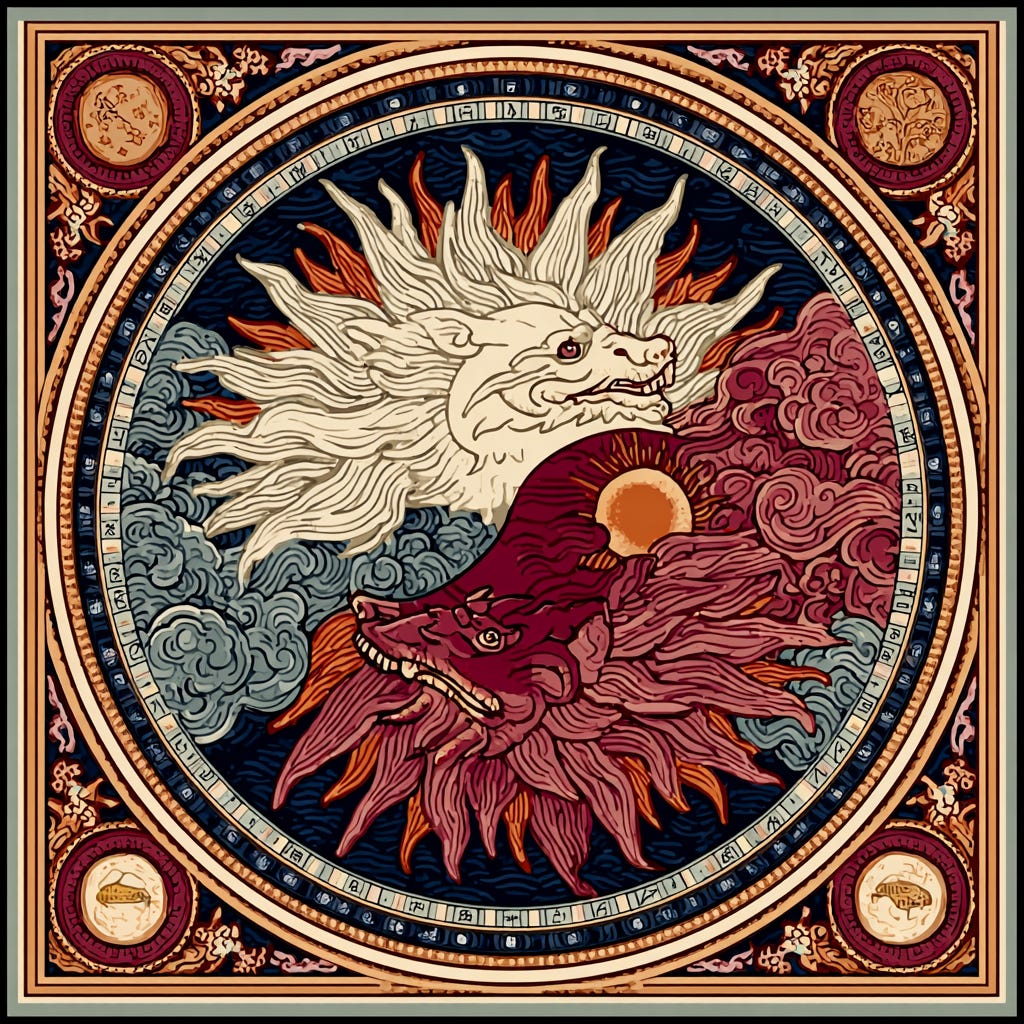
There are two points in the sky that have no mass, no light, no measurable physical presence, and yet every major astronomical tradition in recorded history has given them names, attributed to them enormous power, and built entire cosmological systems around their movement. They are not planets. They are not stars. They are the places where the moon’s path crosses the sun’s path — pure intersection, pure mathematics — and yet the ancient world looked at those invisible coordinates and saw a dragon.
This instinct deserves more than a footnote.
When you trace the nodal traditions across cultures that had no direct contact with each other, what you find is not coincidence. You find convergence. The Vedic sages saw Rahu and Ketu — the immortal head and the severed body of the demon Svarbhanu, condemned to chase the luminaries forever. The Hellenistic astronomers named them Anabibazon and Katabibazon — the ascending and the descending — and attributed to them the power to elevate or diminish fortune. The Maya traced them through Glyph X: the alligator maw that swallows and vomits the divine sign. Egypt encoded them in the lunar phases themselves, in Khonsu the Pathfinder and Sia the one who vanishes. Different tongues, different skies, the same story. The nodes are where the luminaries are swallowed. They are where the soul is asked to change.
What I want to explore here is what that change actually looks like — not as abstract symbolism, but as a lived architecture of surrender and emergence that shows up with uncanny consistency whether you’re reading a Sumerian myth, a Hellenistic text on eclipses, or the theology of early Christian baptism.
The Descending Node: The Gates of Dissolution
The South Node — called Ketu in Vedic tradition, Katabibazon in Greek, associated with the “Death God” in Maya glyphic tradition — marks the place where a celestial body crosses below the plane of the ecliptic. Archetypally, this is the movement of involution. The turning inward. The return to what is already known, already metabolized, already complete.
Ketu is described in Vedic literature as “knowledge without confusion.” I find that phrase worth sitting with for a moment, because on the surface it sounds like praise. Knowledge without confusion — who wouldn’t want that? But the implication runs darker. When knowledge has been so fully absorbed that it requires no thought, no effort, no friction, it has become automatic. And what becomes automatic becomes invisible. And what becomes invisible can no longer teach you anything. Ketu is where you are so skilled that the skill has become a comfortable form of stagnation.
The Sumerian myth of Inanna gives us the most precise map I know for how this dissolution actually unfolds. Inanna, queen of heaven — radiant, sovereign, fully adorned — chooses to descend into the underworld to meet her sister Ereshkigal, the queen of the dead. She is warned. She knows what the descent will cost. She descends anyway.
Seven gates stand between the upper world and the realm below. At each gate, a gatekeeper demands something of her.
The crown first: authority, the external recognition of rank. Then the scepter: the symbols of mission and control. The necklace — voice and social currency. The breastplate — the heart’s armor. The gold ring that sealed agreements and bound obligations. The anklets that marked her ritual movement through the social world. And finally, at the seventh gate, the robe. The persona itself. The last story we tell about who we are when we are too tired to tell a more complicated one.
Each stripping is described in the text with the same neutral phrase: “What is this?” Inanna asks. And the gatekeeper answers: “Be silent. The ways of the underworld must be observed.”
There is no negotiation. There is no exception for royalty.
What the myth encodes is the recognition that the ego’s current costume — no matter how legitimately earned — becomes a barrier at a certain point. The gatekeeper of the South Node does not strip you to humiliate you. It strips you to allow you to reach the essential self underneath the accumulation. When Inanna finally stands naked before Ereshkigal, she is struck with the eye of death and hung on a hook. Symbolic death. Complete cessation of the ego’s current project.
And here the myth stops. For three days, nothing. Heaven mourns. The underworld holds.
Baptismal theology reaches the same place through different architecture. The early immersion rite was not understood as a cleansing in the way we might imagine a shower — surface purification, cosmetic freshness. It was a burial. The water was a grave. To be submerged was to go under with your “Egyptians-in-heart,” the pursuing armies of old habit and old identity, and to allow the water to do what water does to what is submerged long enough. The candidate emerged not refreshed but resurrected — which is a different category of experience entirely.
The South Node, in both traditions, is this: the sacred necessity of allowing something to die so that something else can breathe.
The Ascending Node: The First Breath
Dane Rudhyar, writing in the twentieth century, called the North Node the “Great Intake.” That phrase captures something the clinical language of modern astrology tends to flatten. It is not simply a directional arrow pointing toward growth. It is an act of respiration — the first breath of a new organism, drawing in something that has not yet been metabolized, that feels foreign precisely because it is genuinely new.
Anabibazon. The Greek word means increase, gain, ascent. But the ascent in question is not a return to the prior height. Inanna does not come back to the upper world the same way she went down. Enki’s wisdom-creatures find her on the hook and feed her the water of life and the food of life — and she rises with a knowing she could not have had before the descent. The integration of both territories. The sovereignty that includes, rather than excludes, its own underworld.
This is what distinguishes genuine North Node movement from simple ambition. Ambition can reach for new territory without having surrendered the old costume. The North Node’s hunger — Rahu’s insatiable drive, the alligator maw vomiting the divine sign back into the world — is the reaching of someone who has already been stripped. The crown goes back on, but it sits differently.
Rahu is described in Vedic cosmology as the “immortal head” that perpetually pursues the sun and moon. Perpetually. Never arriving. Never satisfied. And the tradition does not frame this as failure — it frames it as the design. The highest expression of Rahu is the Sadhaka, the spiritual seeker, who uses that fierce pursuit of desire not to acquire but to discover what is actually being sought beneath the surface want. The pursuit itself is the path. The hunger is directional.
The Maya saw emergence through the alligator maw: the deity erupting from the serpent’s mouth, the moment of creation-in-becoming. Egypt named it the crescent moon, the first sliver of light after the new moon’s darkness — associated with Khonsu-the-traveler, the Pathfinder, the Healer responsible for the creation of new life. In the baptismal tradition, the moment of emersion is the moment “the heavens opened” — the soul stepping into a life that could not have existed before the immersion occurred.
What all of these descriptions share is the quality of emergence into something genuinely unknown. The North Node does not feel like coming home. It feels like the non-dominant hand picking up the pen. Awkward. Uncertain. Producing work that is less polished than what the dominant hand could produce — and, for that reason, more alive.
The Axis as Practice
The temptation in any discussion of the nodal axis is to resolve it into a simple directive: stop doing the South Node thing, start doing the North Node thing. Leave the past, embrace the future. This misses the actual teaching.
The Vedic image for the nodal dynamic is the Churning of the Ocean of Milk — gods and demons working together, using the cosmic serpent as a rope, churning the primordial sea until the nectar of immortality rises to the surface. Both sides required. Neither side pure. The gods cannot churn alone. The demons cannot churn alone. The nectar emerges from the collaboration of opposing forces applied to the same axis.
The South Node is not the enemy. Ketu’s “knowledge without confusion” is medicine — the deep, embodied competence that provides the foundation from which new growth becomes possible. Inanna does not descend from a position of weakness. She descends because she is powerful enough to survive it and wise enough to understand that the territory she doesn’t yet know is territory she needs. The crown goes through all seven gates. It is still a crown when it comes back.
The work of the nodal axis is not abandonment. It is the willingness to keep moving — to resist the pull of the comfortable, the mastered, the automatic — and to turn, again and again, toward the direction of emergence. Not because the past has nothing to offer, but because the soul that keeps returning only to the South Node is the sponge in the water too long, saturated and unable to receive anything new.
On the collective level, this dynamic plays out through the planetary nodes — the Descending Node of Saturn-Pluto currently moving through Capricorn, describing a world deeply skilled in rigid institutional governance and unable to stop reaching for that tool even when it has clearly stopped working. The Ascending Node pulling toward Cancer: foundations built on care, on the protection of life as a first principle, on emotional flexibility as a form of structural strength rather than structural weakness.
The collective, like Inanna, is at the gates. The question is not whether the descent is happening — it manifestly is. The question is how much of the regalia we are willing to surrender before we get to the hook.
Three days in the underworld. That is the myth’s timeline. Three days of nothing. Heaven mourning, earth suspended, the old form fully dead before the new life was offered.
I don’t think that’s a number chosen arbitrarily. I think it’s a description of the gap between surrender and emergence — the unbearable interval where you’ve let go of the old costume and the new one hasn’t arrived yet. The nodal axis lives in that gap. It asks you to stay there long enough for something real to grow.
The dragon at the threshold is not your enemy. It is the gatekeeper of what you’re actually becoming.