


Introduction
NB: I base my archetype in focus articles on the ARAS archetypes that are highlighted each month. You can find ARAS on Patreon.
There is a moment at the edge of evening — not quite day, not yet night — when the world seems to hold its breath. The light goes soft, shadows lengthen, and ordinary things acquire an odd luminosity, as if seen slightly sideways. It is precisely in this margin that fairies live. Not in full daylight, where everything is accounted for, and not in the full dark, where fear has its own blunt grammar. They inhabit the threshold: the crepuscular, the in-between, the not-quite-real. And it is there that they have always done their most consequential work.
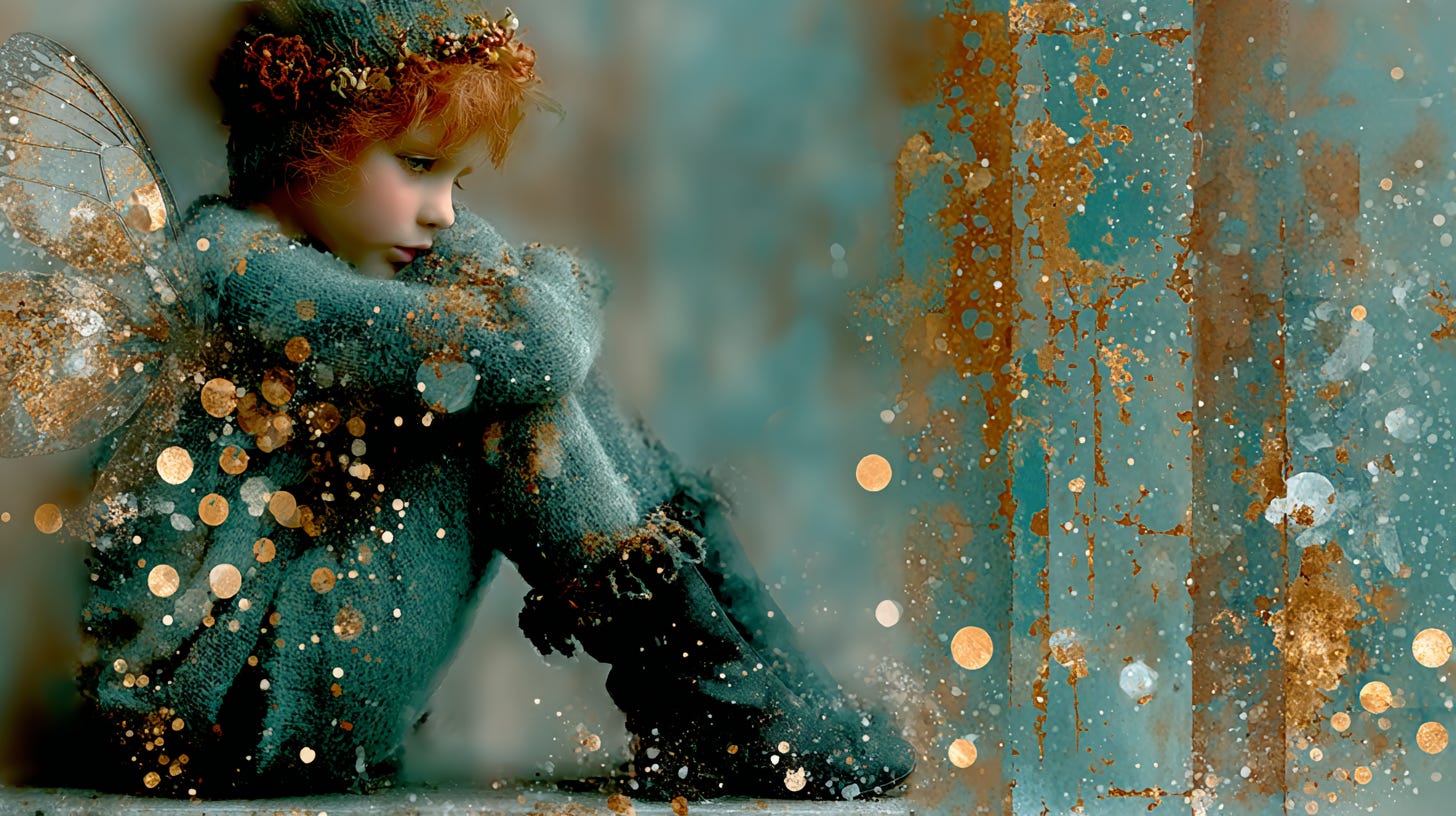
The fairy archetype belongs to the oldest strata of human imaginative life. Long before Shakespeare gave us Titania and Oberon, before J. M. Barrie sent Tinkerbell into the nurseries of the modern world, before Tolkien mapped the boundaries of Middle Earth, there were the little people. The shining ones. The Good Folk, named with careful flattery so as not to invite their mischief. Their presence in the cultural record stretches from Irish and Scottish folklore through the Germanic Elfen, the Scandinavian Huldre, the Slavic Rusalki, the Japanese Tengu, and beyond. Wherever human beings have felt the uncanny nearby, wherever they have sensed that the visible world was not the whole story, something fairy-like has materialized.
The ARAS material on this archetype opens with etymology as a kind of key: the word “fairy” links both to fayre (illusion) and to the Latin fata (fate). These two roots are not incidentally related. Together they tell us that the fairy is an agent of altered perception who operates in the register of destiny. To see a fairy is to have your consciousness shifted; to encounter one is to have your fate touched. The fairy is the place where the randomness of enchantment and the logic of cosmic order briefly, eerily coincide.
This essay moves through that convergence in three directions. It begins with the cultural and symbolic life of the fairy across traditions and time — the range of figures, the paradoxes of character, the specific domains of fairy power. It then turns to the astrological framework through which the fairy archetype finds its deepest resonance, centering on Neptune, the 12th house, and the Moon in her more liminal phases. Finally, it draws these threads together, tracing how the fairy speaks to something recurrent in the psyche: the non-rational, the synchronistic, the generative power that lives just outside the reach of ordinary knowing.
Cultural and Symbolic Exploration
The Taxonomy of the Tiny
The word “fairy” is less a single figure than a family of beings. The ARAS source offers a useful census: elves, brownies, pixies, fays, leprechauns, nymphs, sprites. They range in size from a thumbling to the height of a three-year-old child. Some wear gaudy finery; others dress in simple homespun, the garments of workers and craftspeople. This is the first paradox the archetype presents: the fairy is simultaneously aristocratic and rustic, otherworldly and domestic.
In the British Isles, brownies were household spirits — essentially the fairy in its most utilitarian guise. They would work through the night spinning, sweeping, and tending livestock in exchange for a bowl of cream or a small gift left near the hearth. Treat them well and your household flourished. Forget the offering, or worse, give them clothing (an act read as dismissal), and they would leave without warning, taking their invisible industry with them. The leprechaun of Irish tradition worked as a cobbler, the tapping of his hammer the only auditory evidence of his presence. The pixies of Devon and Cornwall led travelers astray on the moors, not from cruelty exactly, but from something closer to irrepressible impishness. The nymphs of Greek antiquity inhabited springs, trees, and grottos — a living presence woven into the natural world, capricious but not malicious.
What all these figures share is a relationship to the hidden labor that sustains the visible world. The fairy performs the work that no one sees. They keep the household in order, they cobble the shoes, they work the mine, they spin the thread. In this sense they are functionally close to what analytical psychology would call the autonomous complexes of the unconscious — the patterns and energies that operate below the threshold of awareness, shaping outcomes without being directed. You do not tell a brownie how to clean the house; it simply does, by its own logic, in the dark.
The Shape of Mischief
But fairies are not reliable workers or benevolent helpers in any simple sense. The ARAS material is emphatic on this point: as shapeshifters and tricksters, they are as capable of havoc as of help. The love potion administered to the wrong recipient, the soured milk, the misplaced keys, the accident that befalls those who disturb a fairy ring — these are not aberrations from the fairy’s nature. They are the other face of it.
Puck, in A Midsummer Night’s Dream, is the clearest literary embodiment of this duality. He transforms Bottom’s head into a donkey’s; he applies the love potion to the wrong sleeping Athenian eyes; he confuses night travelers for sport. His famous line — “Lord, what fools these mortals be!” — captures the fairy’s characteristic attitude toward human seriousness. He does not apologize for the chaos he generates. He observes it with a kind of affectionate contempt, as if the disorientation itself is the lesson: you were too certain, too sure of the fixed order of things.
The changeling myth extends this logic into darker territory. Fairies were said to steal human children and leave their own offspring — often sickly, strange, and difficult — in their place. Parents who found their child suddenly altered, unresponsive, consuming without growing, recognized the changeling motif. In sociological terms, this belief served as a framework for understanding and contextualizing children who were different: those who seemed to have arrived from somewhere else, who didn’t fit, who operated by an interior logic their families couldn’t access. The fairy world, in other words, offered an explanatory mythology for neurodivergence, for unusualness, for the child who simply would not comply with the expected human shape.
Fate and the Newborn
The ARAS etymology linking fairy to fata becomes most vivid in the fairy tale of Sleeping Beauty. Here the fairies arrive at the cradle to pronounce blessings — beauty, grace, song, goodness — and then the uninvited dark fairy arrives to pronounce a curse. The structural logic of the tale turns entirely on this scene: fate is not singular but multiple, layered, sometimes in conflict with itself.
This motif has deep cultural roots across Europe. In ancient Rome, the Fata — female fate beings — were believed to attend every birth. The Germanic Norns spun, measured, and cut the thread of destiny. The Greek Moirai performed the same threefold function: Clotho spinning, Lachesis measuring, Atropos cutting. The fairy godmother of later tradition is a softened, domesticated version of this figure — still fate-bearing, still carrying powers that transcend ordinary human will, but now more reliably benevolent, present to bestow gifts rather than impose unavoidable destinies.
What this cross-cultural pattern encodes is a profound ambivalence about causation. Human beings have always sensed that their lives are not entirely under their own direction. There are forces at work that are neither random nor comprehensible — that feel purposive without being predictable, that feel personal without being consciously controlled. The fairy, especially in its fata aspect, is the face given to that experience. It is the non-rational operating with uncanny precision.
Twilight, Fairyland, and the Unconscious
The ARAS profile is clear that fairies are “associated especially with the uncanny transformations of twilight and night.” They inhabit Fairyland, Dreamland, Never-Never Land, Middle Earth — all of which the source explicitly connects to “the unconscious dimension and psyche’s secret workings.”
This is the hermeneutic key to the archetype’s symbolic depth. Fairies do not appear at noon. They do not operate under the unambiguous overhead light of full solar consciousness. They appear at the edges: at dusk, in mist, at the boundary of the forest, at the liminal moment between sleeping and waking. This is not incidental. The fairy’s domain is structural — it is the threshold state itself, the condition in which ordinary categorical boundaries dissolve just enough for something else to come through.
The Irish tradition of the Sidhe, the fairy mounds, makes this geography explicit. The fairy world lies beneath the visible world, accessible through specific portals — a hollow hill, a fairy ring of mushrooms, a particular body of water at a particular time of year. The Celtic festival of Samhain, our current Halloween, was the moment when the veil between worlds grew thin. The dead could return; the fairies could cross into human space. This is not metaphor; or rather, it is metaphor that was also experienced as literal — the felt sense that the boundary between known and unknown, visible and invisible, had softened.
James Hillman’s alchemical psychology offers a useful frame here. Hillman argued that psychological health requires all three registers of language: thing-words (concrete and literal), image-words (poetic and symbolic), and craft-words (process and making). The fairy operates almost entirely in the register of image. It is not a thing — it is not a material creature you can pin down, document, or photograph with confidence. It is an image: luminous, unstable, meaningful in a way that resists paraphrase. The fairy’s evanescence is its nature. The moment you try to fix it, to make it literal, to reduce it to a thing, it vanishes.
Astrological Framework
Neptune: The Planet of Enchantment
If any planet claims the fairy archetype as its own, it is Neptune. In the Hellenistic whole-sign framework, Neptune’s significations — illusion, dissolution, enchantment, the thinning of boundaries, the dissolution of the ego-self into something larger — map almost perfectly onto the fairy’s symbolic profile.
Consider the etymology again: fayre, illusion. Neptune is the planet of illusion par excellence. It governs glamour in both the modern and archaic senses of the word — glamour originally meant a magic spell, a glamour cast over the eyes that made things appear other than they were. Neptune transiting a natal planet can produce precisely this effect: a period in which something appears more luminous, more perfect, more fated than it actually turns out to be. The enchantment is real, but its content is not always trustworthy. This is the fairy’s double nature translated into planetary language.
Neptune also governs the dissolution of categorical boundaries — between self and other, between sleeping and waking, between the human and the numinous. The fairy world lives in exactly this dissolution. Fairies do not acknowledge the same boundaries humans maintain. They cross into human life when they choose, by routes invisible to ordinary perception. Their relationship to time is non-linear. Their moral logic is not human moral logic. Neptune, similarly, does not recognize the sharp edges of Saturnine form. Where Saturn builds walls, Neptune seeps through them. Where Saturn insists on definitions, Neptune dissolves them.
The 12th house in whole-sign astrology — associated with hidden matters, solitude, spirituality, and loss — is Neptune’s natural domain and the astrological space most resonant with the fairy. The 12th house is the house of that which is not yet conscious, not yet named, operating below the threshold of the ego’s awareness. It is, in the language of the Hellenistic tradition, the house of the “Bad Daimon” — not evil, but hidden, working at a remove from the light of ordinary awareness. Planets in the 12th operate from this background register: their energy is present, influential, and largely invisible to the person who carries them. This is, again, a structural description of how fairies work in folklore. They are the unseen household workers, the invisible forces that shape outcomes, the background intelligence the conscious mind has not thought to account for.
The Moon: Luminosity, Phase, and the Liminal
The Moon brings a second, equally essential astrological lens to the fairy. The ARAS source emphasizes the fairy’s association with twilight, with night, with the uncanny transformations of threshold time. All of this belongs to lunar territory.
In Hellenistic whole-sign astrology, the Moon governs the emotional body, the fluctuating self-image, the tidal pull of the unconscious on conscious life. She reflects rather than generates light — her illumination is borrowed, indirect, and phase-dependent. This is exactly the fairy’s mode: the fairy does not command the spotlight. It appears in reflected, ambient, marginal light. Its presence is sensed before it is seen.
The Balsamic Moon phase carries particular resonance for this archetype. The Balsamic phase — the waning crescent just before the New Moon — is the moon at her most liminal. She is barely visible, riding just ahead of the Sun in the pre-dawn sky, carrying the exhaustion of a completed cycle and the strange luminosity of what is about to begin. The Balsamic phase is associated with endings, closure, the prophet-like quality of those who can sense what is coming before it arrives. There is something deeply fairy-like in this: the creature who inhabits the edge of one world and the beginning of another, who carries a kind of knowledge that has no name yet.
The Dark Moon — the period of complete invisibility just before the New — extends this into the fairy’s most hidden register. This is the moon at her most interior, her most secret. What gestates there, what intelligence operates in that darkness before the new cycle begins, is precisely the kind of non-rational generative energy the ARAS source describes: “amoral, luminous, and highly generative impulses that are agents of the psyche’s non-rational energies and synchronistic happenstance.”
The 3rd Harmonic, Sextile, and the Playful Mind
A less obvious but resonant astrological signature for the fairy archetype is the sextile aspect and the third harmonic. The sextile — 60 degrees — is classically associated with opportunity, ease, and the kind of assistance that arrives without being demanded. It is the aspect of helpful coincidence, of doors opening when you weren’t quite looking, of the right thing appearing at the right moment. This is fairy logic exactly: the serendipitous helper, the impoverished spinner who wakes to find the straw turned to gold, the cobbler who returns to his workshop and finds shoes made overnight by invisible hands.
The third harmonic (aspects that divide the circle by three: trines and their subdivisions) is associated with creativity, flow, and the playful intelligence that moves easily between states. Fairies in lore are masters at transformation, at moving between forms, at doing effortlessly what mortals labor over. The fairy’s relationship to craft — tailoring, spinning, washing, planting, mining — is not labored but natural, an expression of a being that is, at its core, aligned with the generative principles of the world.
Cross-Cultural and Astrological Integration
Synchronicity as Fairy Logic
Carl Jung’s concept of synchronicity — the acausal connecting principle — offers a bridge between the fairy’s cultural manifestations and its astrological resonance. Synchronicity, as Jung described it, is the experience of two events that are not causally connected but that carry a shared meaning. The coin falls open at the relevant page; you think of a friend and the phone rings; the pattern in the natural world mirrors the pattern in the interior life.
This is precisely what fairy appearances enact in folklore. The fairy does not arrive through cause and effect. It does not respond to commands or summons in any reliable way. It appears at the moment of need, or at the moment of readiness, or seemingly at random — but always charged with significance. The encounter always matters; it always changes something. The fairy operates in the register of synchronistic causality, not mechanical causality. This is a Neptune/12th house mode of operation: events that feel fated, that arrive from outside the chain of ordinary intention, that carry a numinous charge.
The evolutionary astrology framework (Jeffrey Wolf Green) adds another layer here. The primary evolutionary axis — Pluto, the lunar nodes, and their rulers — encodes the Soul’s non-linear journey across many lifetimes. The fairy, as a fata figure, is an agent of fate in exactly this trans-personal sense. The encounter with a fairy in folklore is not an event that happens to the ego; it is an event that happens to the Soul’s trajectory. It accelerates something, redirects something, bestows a gift or a curse that will reverberate across time. This is the language of the Pluto axis: the meeting that cannot be explained by the logic of the single life, that makes sense only in the longer arc.
The Trickster Current
The fairy’s trickster dimension connects it to a pattern that appears across mythologies: Hermes in Greece, Loki in Norse tradition, Anansi in West African and Afro-Caribbean lore, Coyote in indigenous North American traditions. In every case, the trickster is the figure who disrupts fixed order — who steals fire, who reshuffles hierarchies, who makes the serious look absurd, who finds the route through the walls that were supposed to be impassable.
Astrologically, this energy is associated with Mercury in its more transgressive modes — the psychopomp, the guide between worlds, the lord of thresholds who moves between the living and the dead, between the divine and the human. Mercury’s sextile to the ascendant, or Mercury placed in the 8th or 12th house, or Mercury at the Balsamic phase relative to the Sun — these signatures carry something of the fairy’s mercurial mischief.
But the trickster’s disruptions are never simply chaotic. In nearly every tradition, the disruption produces a gain — not always the gain the protagonist wanted, but one that turns out to be necessary. Puck’s meddling resolves the romantic impasse in A Midsummer Night’s Dream. Loki’s treacheries, for all their catastrophic consequences, are also the source of some of the Norse pantheon’s most powerful objects and gifts. The brownie who hides the gloves in a messy house is annoying, certainly; but the house does need tidying. The fairy mischief functions as a corrective from the unconscious, forcing the necessary adjustment that the ego was avoiding.
This maps precisely onto the astrological experience of Neptune transits. A Neptune transit to natal Saturn, for example, can dissolve structures that had become too rigid — and this dissolution, while often disorienting, sometimes even devastating in the short term, tends to produce a more supple relationship to reality in the long run. The fairy takes the keys and the gloves so that you will notice the mess. The mess, once noticed, can be addressed.
The Fairy as Daemon Soul
The evolutionary astrology concept of Daemon Souls — those deeply oriented to nature, animals, and the hidden life of things, in communion with what the tradition calls devas or spirits within nature — is one of the most direct bridges between astrological typology and the fairy archetype. Daemon Souls, in the JWG framework, often experience alienation from mainstream society; their healing involves returning to and actualizing their natural nature.
Many of those who throughout history reported fairy encounters, who claimed to hear the fairy music or to have been led into the fairy ring, appear to have been operating in this register. They were sensitive to a layer of the world that others moved through without perceiving. The fairy was not a delusion for them but a perception — a perception of the non-rational generative intelligence that saturates the natural world, that the ARAS material calls “luminous and highly generative impulses.”
The 12th house and Neptune, combined with a strong Moon or a significant Balsamic phase emphasis, can mark someone who habitually inhabits the liminal. Who notices the threshold moments, who is drawn to the edges of categories, who senses that the visible world is only half the story. This is not pathology, though it can feel that way in a culture that prizes the solar, the concrete, the fully visible. It is a specific kind of attunement — the fairy’s own attunement, turned inward.
The fairy archetype is, at its core, a record of the psyche’s encounter with its own non-rational depths. Every culture has generated these figures because every culture has needed to think about the forces that operate just below the threshold of conscious understanding: the invisible workers who sustain the household, the fate-bearers who arrive at the cradle, the tricksters who disorder what has grown too certain, the threshold-dwellers who embody the possibility of transformation.
Astrologically, the fairy finds its home in the combination of Neptune’s dissolving enchantment, the Moon’s liminal luminosity in her darker phases, the 12th house’s background intelligence, and the sextile’s synchronistic grace. Together these signatures describe a psyche capable of operating in the register of fata — sensitive to the currents that run beneath ordinary causality, tuned to the synchronistic logic that the ego tends to overlook.
To take the fairy seriously as an archetypal figure is to take seriously the reality of the non-rational in human life. Not as chaos to be suppressed, not as madness to be medicated, but as a specific kind of intelligence: impish, evanescent, fate-adjacent, and generative. The fairy hides your keys because the house is messy. It soils the milk when it has been taken for granted. It leads you off the path when you have become too certain of where you are going. And sometimes, if you leave out the cream and keep your end of the bargain, it spins the straw into gold by morning.
The fairy’s gift is the gift of altered consciousness — not permanently, not reliably, not on demand. At twilight, in the liminal moment, at the edge of what is known. As above, so below. The tiny wings in the peripheral vision are the psyche’s own reminder that the world is larger, stranger, and more alive than the daylight mind tends to admit.