


What the same Moon can mean in two opposite directions, and why that matters for your hardest placements
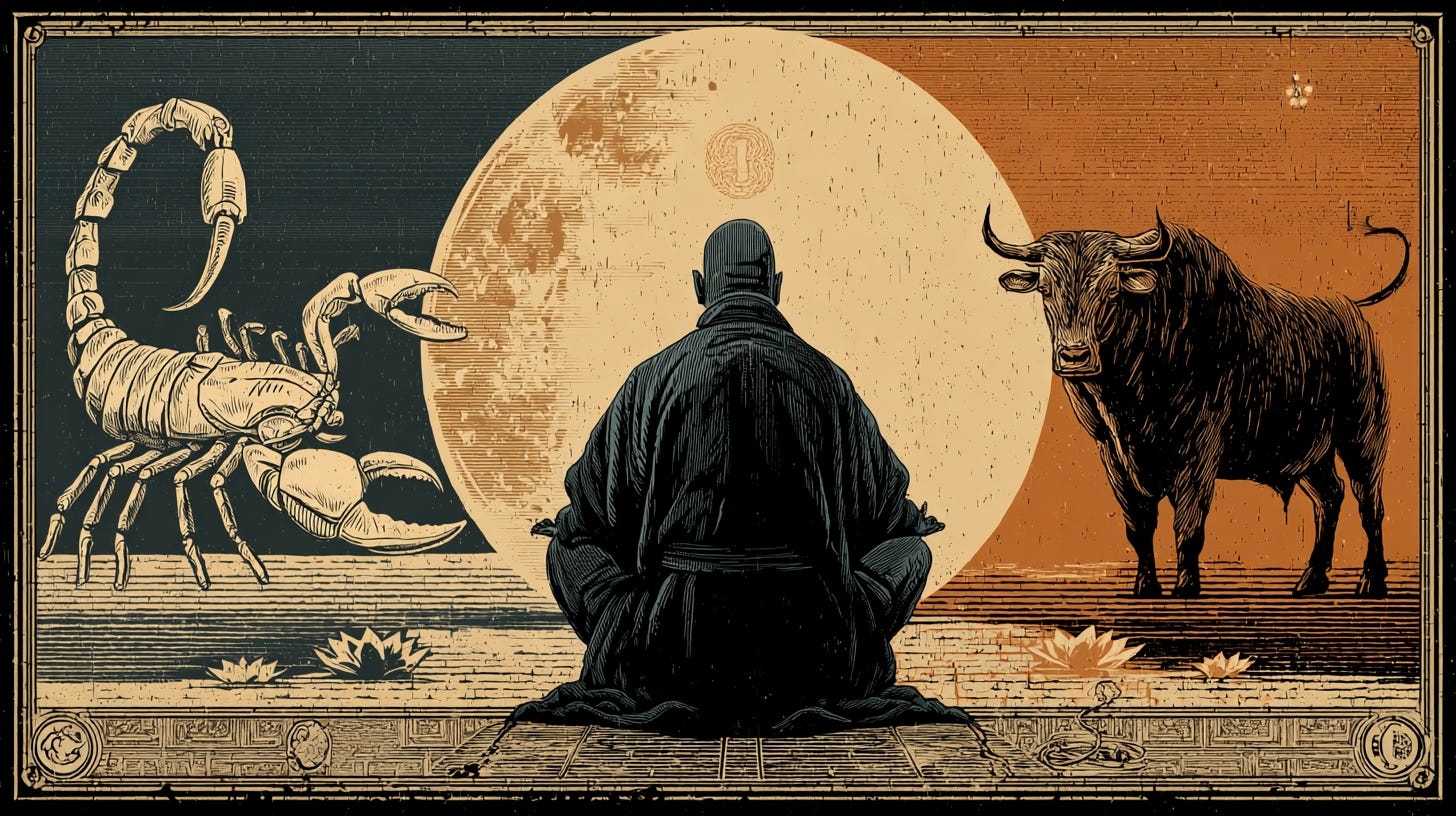
Stand under a full moon, and you are looking at a fruit at the moment it can be picked.
That’s the first thing I want you to sit with. Not the metaphor’s prettiness, but its precision. A fruit at perfect ripeness has reached the end of one operation and the beginning of another. Sweetness and weight, the hold of the stem, the slight slip when a hand brushes it — these are not signs of a process completing inside the fruit. They are signs that the fruit is now ready to do something else. To be picked. To be eaten. To fall and decompose. To become the next thing.
I’ve just finished a long-form work on a particular full moon — the one twenty-five hundred years ago, on the night the Buddha is said to have awakened — and I want to tell you what’s in it. Not because the Buddha’s awakening is the topic, exactly. Because the configuration of the heavens that night is a map, and the map describes something every astrologer has been trying to read in their own clients and in their own lives: the moment when a placement that looks like trouble is actually the operation working as designed.
The book is called The Sovereign Sacrifice. It’s about 177 pages, drawn from four of the world’s surviving technical esoteric traditions — Hellenistic astrology, Vedic sidereal astrology with its 27-fold nakshatra system, Tantric Buddhist iconography, and the alchemical literature that runs from the Tabula Smaragdina through Jung’s Mysterium Coniunctionis. It is technical where it has to be and contemplative where the symbolism asks for it. But everything in it points back to a question I think most of you who read FindYourNova have asked, in one form or another: why is the chart hard right where I most need it not to be?
The answer the book offers is unusual, and I think it’s the answer.
The Riddle
Buddhist tradition preserves the sky-coordinates of the night the Buddha awakened with unusual precision. The lunar month was Vaiśākha. The Moon was full. The Sun stood in Taurus, the Moon directly opposite in Scorpio. Venus rose in the east as the morning star while Siddhārtha Gautama touched the earth and became the Buddha. This is more than calendar piety; it is a technical statement, the kind that astrologers spend lifetimes decoding.
And here is the riddle. The Hellenistic tradition — the one Robert Schmidt, Robert Hand, Demetra George, and Chris Brennan have spent decades recovering — reads the Moon in Scorpio as her place of fall, the tapeinōma, her depression. The locus of greatest debility. No planet is exalted in Scorpio because that’s the Moon’s place of trial. Mars rules it. The waters are fixed, sometimes brackish. Where the exalted Moon in Taurus is the cow whose flanks overflow with milk, the fallen Moon in Scorpio is the same nourishing principle dragged into the underworld.
The Vedic sidereal tradition, working with the same lunar position at the same moment in history, reads it as the Moon walking through the nakshatras of Viśākhā — “the forked branch,” whose symbol is the toraṇa, the triumphal archway — and Anurādhā, the lotus blooming in muddy water, presided over by Mitra, the Vedic deity of compassionate friendship. Hellenistic doctrine seems to say: the Moon is at her weakest. Vedic doctrine seems to say: the Moon is at her highest goal.
How can a single sky speak in two directions at once?
The book argues that the apparent contradiction is the key. The two systems are not in error, and they are not describing different things. They are describing the same operation from opposite ends. The Hellenistic “fall” is the operation — the heat applied, the descent into the workshop. The Vedic “arch” is the result — what walking through that descent actually accomplishes. The mud is what allows the lotus. The fall is the gateway.
If you’ve ever had an astrologer tell you a placement is “difficult,” and another astrologer tell you the same placement carries a particular gift, and you went home feeling more confused than before — this is what was happening. Both readers were right. Neither had the whole map.
What the Seven Movements Actually Cover
The argument unfolds in seven movements. Let me sketch each one quickly so you can see the shape of the whole.
Movement I — The Full Moon as the Ripened Ego. The Moon at maximum light is the ego at maximum visibility. Hellenistic tradition calls the Moon the mediatrix, the threshold-keeper between the heavens and the body. Sāṃkhya philosophy calls her ahaṃkāra, the I-maker — the part of the mind that organizes everything that arises into the felt sense of “this is me, continuous over time, separate from others.” When the Moon reaches her peak, that organizing function is most fully crystallized. You feel most yourself. And that is exactly the moment something interesting becomes possible. Because what is fully visible can be fully met. What can be fully met can be set down.
Movement II — The Lunar Paradox. This is the technical heart of the book, the chapter where I work out the Hellenistic dignity scheme and the Vedic nakshatra system side by side. The reader who wants the mechanics — the dignity tables from Dorotheus and Ptolemy, the philological dig on tapeinōma, the structure of the 27 lunar mansions, who Mitra was in the Ṛgveda before he became Mithras and Mithra and Mithra-Varuṇa across the Indo-Iranian world — will find them here. The takeaway, though, is non-technical: the descent is the destination. The chart is not failing you. The chart is precisely describing what is being asked.
Movement III — The Diamond Throne. Every culture that ever revered the bull was teaching the same thing: stillness is what makes everything else possible. The Sun in Taurus at this Full Moon is the vajrāsana, the diamond seat, the foundation that turns the Scorpio descent into awakening rather than dissociation. The Buddha sat on a stone slab carved during the Mauryan period that is still preserved at Bodh Gayā today. He reached down with one hand and the earth herself bore witness. This is iconography, but it’s also nervous-system regulation translated into stone. You cannot do the descent without the seat. Run a descent without the seat and what you get is not awakening; it is dissolution. The book devotes considerable space to what the seat actually looks like in practice — the root chakra in the subtle-body literature, the polyvagal nervous system in Stephen Porges, the simple felt-sense of being grounded in the body.
Movement IV — The Wrathful Waters. The Buddha did not destroy Mara. He recognized him. The wrathful feminine across traditions — Kālī, Durgā, Sekhmet, the Tibetan dākinīs — is not the enemy of awakening but its surgeon. The blade is a tool, not a weapon. The book walks the four Maras of canonical Buddhist tradition (the affliction-Mara, the aggregate-Mara, the death-Mara, the divine-son-Mara) and the central Tantric move of feeding the demons rather than fighting them. It also handles the technical doctrine of mutual reception by domicile in Hellenistic astrology — the way Mars in Scorpio and Venus in Taurus, in the Buddha’s chart, were each in the other’s home, integrating across the same axis the Moon and Sun were lighting up. Anger and love are not opposites. They are the same force at different temperatures.
Movement V — Sect, the Three Watches, and the Morning Star. The Buddha’s awakening was an all-night vigil. Three watches of the night, three depths of insight: in the first watch, recollection of past lives; in the second, the divine eye that sees the karmic patterns of beings; in the third, the uprooting of the deepest unconscious roots of suffering. At dawn, Venus rose in the east as the morning star. This chapter walks the doctrine of sect in Hellenistic astrology (the doctrine that planets divide into day and night teams, with a sect-light leading the work), the meditative gold-window of the brāhma muhūrta before sunrise, and the cross-cultural mythology of the morning star — Inanna’s descent, Lucifer in its pre-Christian sense, the Vedic Aśvins, Quetzalcoatl. Every culture that watched the sky watched Venus at dawn, and every culture saw the same thing: the herald of the new day.
Movement VI — The Axial Age in the Heavens. The Buddha did not awaken alone. Within a single century, Confucius was teaching in China, Pythagoras was teaching number and harmony in Greece, Mahāvīra was walking in India, the Hebrew prophets were writing in the Levant, Lao Tzu was, by tradition, composing the Daodejing. Karl Jaspers called this the Axial Age — the period when humanity collectively shifted its center of gravity from outer ritual to inner work. The book situates the Buddha’s awakening in this larger turning, walks the Jupiter-Saturn conjunction cycle that astrologers have always used to read mundane time, and offers a gentle treatment of precessional ages that doesn’t ask you to commit to any particular cosmology. Your awakening is part of something larger. That helps.
Movement VII — The Sovereign Sacrifice. The culminating chapter. The motif of the king who must die for the kingdom recurs across cultures — the Indo-European aśvamedha (horse sacrifice), Norse Odin self-sacrificed on Yggdrasil, the Egyptian Pharaoh’s Sed festival of ritual death and renewal, the Christian priest who is also the victim, the Aztec deity-impersonator who lived as a god for a year before being offered. What is sacrificed in each case is not the person but the person’s claim to sovereignty. The ego steps down off its own throne. What rises is not a renovated king but a free human being. The book reads the Vaiśākha pūrṇimā configuration as the precise astrological signature of this operation — and then closes with a practical chapter on how it returns in your own life. The second Saturn return at fifty-eight or fifty-nine years old. The Uranus opposition around forty-two. The Pluto square Pluto in the late thirties. The transit Sun and transit Moon in opposition across the Taurus-Scorpio axis whenever it recurs annually. This is not antiquarian symbol-collecting. The configuration is a working diagram, and it recurs.
What This Has to Do With Your Chart
Here is the part I most want you to take away.
If you have a placement in your natal chart that has been called difficult — Moon in Scorpio, Saturn in fall, Mars in detriment, a tight square between two malefics, a stellium in a sign that is not the planet’s preferred home — the book’s argument applies. Difficult is not failure. Difficult is the operation. The chart is precisely describing what is being asked of you, in the technical language that has been preserved for two and a half thousand years for exactly this purpose.
That doesn’t mean the difficulty is romantic, or that you should be glad about it. The difficulty is real. The work is real. The cooking takes years sometimes. But the placement is not the chart’s mistake. It is the chart’s instruction.
What changes when you read it that way: the sense that the chart is for you rather than against you. The shift from “this is the part that’s broken” to “this is the part that knows what it’s doing.” A different relationship with your hardest territory.
This is what the book exists to argue. It is also what the Buddha enacted under the pipal tree on a Full Moon in Vaiśākha at some date in the sixth or fifth century BCE that we cannot pin down with certainty. It is also what the configuration of the heavens has been quietly waiting to do every May since.
Where to Read More
If you want the whole architecture — the primary sources from the Pāli Canon and the Sanskrit Mahāyāna sūtras, the Hellenistic dignity tables and the Vedic nakshatra mechanics, the Tibetan iconography and the alchemical sequence, the bibliography organized by tradition and the glossary of every Sanskrit, Pāli, Greek, and Tibetan term used — The Sovereign Sacrifice is available as a 177-page downloadable PDF:
I am also recording a full eight-part video series walking each movement and a separate practical guidance video for the May 1, 2026 Full Moon. The series is on my YouTube channel:
This is for astrologers willing to read across traditions, for contemplative practitioners drawn to the technical underpinnings of the Buddha’s awakening narrative, and for symbolic thinkers who want to see how four of the world’s most rigorous esoteric languages converge on a single configuration of the heavens.
The Moon will be full again. The Bodhi tree still grows. The chart that opened beneath Siddhārtha is the chart that opens within any practitioner who has been brought, by their own ripening, to the threshold of the Sovereign Sacrifice.
Whenever you’re ready.
— Ryan