


For a long time, I thought I understood the Moon.
I could talk about Moon signs. I could describe someone’s emotional pattern with reasonable accuracy. I could explain why a Cancer Moon clings or why a Capricorn Moon withholds. It all worked. Clients nodded. The symbolism held.
And yet something about it felt small.
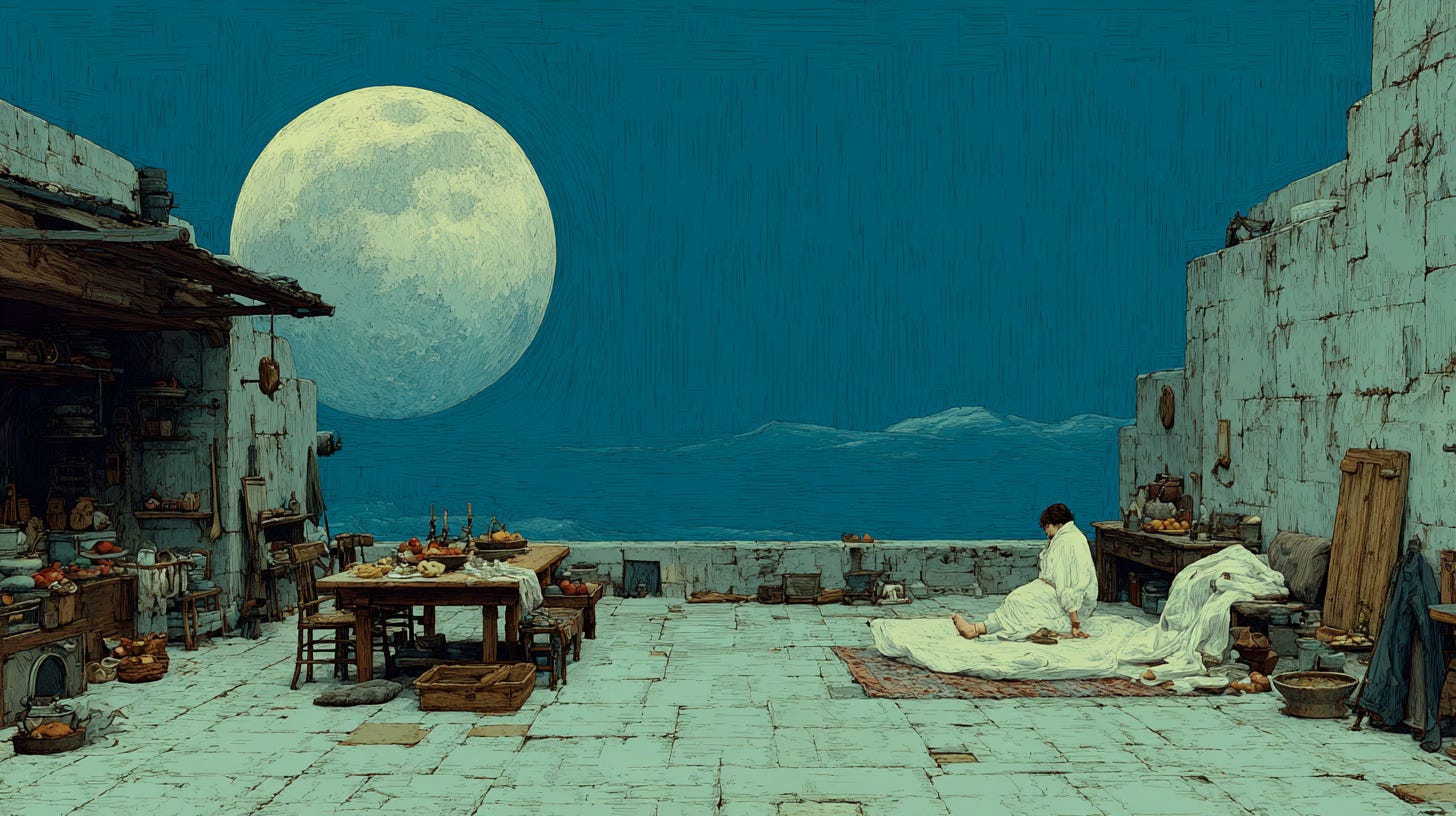
It wasn’t until I moved apartments three times in two years living in Hong Kong that the Moon started to mean something else to me. Each space changed how I slept. Changed how I worked. Changed what I ate. In one apartment, I couldn’t rest. In another, I stopped cooking. In the third, everything slowed down and my thinking changed with it. Nothing in my chart had shifted dramatically — but my environment had.
That was the beginning of understanding the Moon differently.
In the older cosmology, the Moon was the final sphere before the realm of generation and decay. Above it were the more enduring heavens. Beneath it was this world — flesh, water, fabric, bone, metal, breath condensing into visible life. Everything that grows and withers belongs here.
The Moon was the threshold.
I used to read that symbolically and move on. Now I read it more literally.
The Moon governs tangibility.
Saturn defines edges. It gives things their outline. It separates one space from another. A wall divides inside from outside — that dividing function belongs to Saturn. But when you lean your shoulder against the wall and feel its temperature, that’s something else. The coolness. The weight. The sensation of resistance.
That belongs to the Moon.
The Sun animates. Breath, vitality, coherence of self — those are solar. But breath requires lungs. Vitality requires tissue. Identity requires a body to inhabit. The Moon is the field of matter that receives and holds animation.
Without the Moon, light would pass through nothing.
I think this is where modern astrology shrank the symbol. We turned the Moon into mood. But mood is only the most immediate ripple of something deeper.
The body itself is lunar.
Yes, the rising sign describes appearance. It describes the body as it presents. I’ve seen that hold up too many times to dismiss it. But appearance isn’t substance. The body is moisture and repetition. It is hunger at predictable hours. It is sleep that either restores or doesn’t. It is the way tension accumulates in the jaw long before you realize you’re anxious.
That accumulation, that storing? That’s lunar.
I’ve watched people chase spiritual clarity while ignoring their sleep, their food, their physical space. I’ve done it. Long nights reading charts, eating badly, surrounded by clutter, convinced that insight alone would stabilize everything.
It doesn’t.
You can’t pour revelation into a body that isn’t being tended.
The ancient idea that everything beneath the Moon is subject to growth and decay sounds abstract until you watch it in your own kitchen. Fruit ripens and rots. Bread hardens. Plants lean toward light and then collapse inward. The same pattern is happening in your muscles, your skin, your digestion.
The Moon governs that rise and fall.
Cooking is lunar. Cleaning is lunar. Folding laundry is lunar. None of it is glamorous, but all of it shapes the field in which you live. When my kitchen is chaotic, my thinking becomes chaotic. I don’t have a more elegant explanation than that. It’s just observable.
The Moon rejoices in the third house — the near world, the daily routes, the small movements that repeat. I didn’t understand that until I noticed how driving the same streets every day shaped my mood. The car itself is engineered by Saturn and powered by Mars, yes, but the experience of being enclosed, carried, moving through familiar space with hands on the wheel, that repetition becomes part of the body’s rhythm.
You start to feel when your near world is misaligned.
Houses are the same way. A house has beams and boundaries, but once you live inside it, it becomes something else. It absorbs arguments. It holds laughter. It remembers illness. It preserves photographs in drawers. It gathers smell and sound and residue. I’ve walked into old homes and felt the weight of what happened there. Maybe that sounds sentimental. I don’t think it is. Matter records.
The Moon reflects light. It doesn’t generate its own. That reflection is not passive. It receives and redistributes. The body does the same. Early childhood makes this obvious. Before you can analyze tone, you absorb it. Before you can interpret tension, you feel it.
The body keeps score in ways the mind cannot immediately rewrite.
That’s lunar.
When someone asks about their Moon now, I’m less interested in how they “process emotions” and more interested in how they inhabit their life.
How do you sleep?
That question alone tells me more than most interpretive keywords.
Do you wake rested? Do you wake already tense? Do you eat at regular hours or only when you remember? Is your home arranged in a way that supports you, or are you tolerating it?
These aren’t lifestyle questions. They’re lunar questions.
The Sun can illuminate purpose. Jupiter can expand belief. Venus can harmonize beauty. Saturn can define discipline. But if the body is exhausted and the home is disordered and the daily rhythms are fractured, none of that stabilizes.
Everything must pass through matter.
Everything must become touchable.
Sometimes I think we want astrology to lift us above the world — above decay, above repetition, above laundry and dishes and sleep. But the Moon keeps pulling us back down into contact.
You don’t transcend the sublunar world.
You live in it.
Your house shapes your habits. Your car shapes your routes. Your food becomes your flesh. Your rooms either calm your nervous system or agitate it.
You are constantly being shaped by what you touch.
And that shaping is not accidental. It’s rhythmic. It’s cyclical. It waxes and wanes.
The Moon is not just the part of you that feels.
It’s the part of reality that can be held.
And we spend our entire lives inside it.