


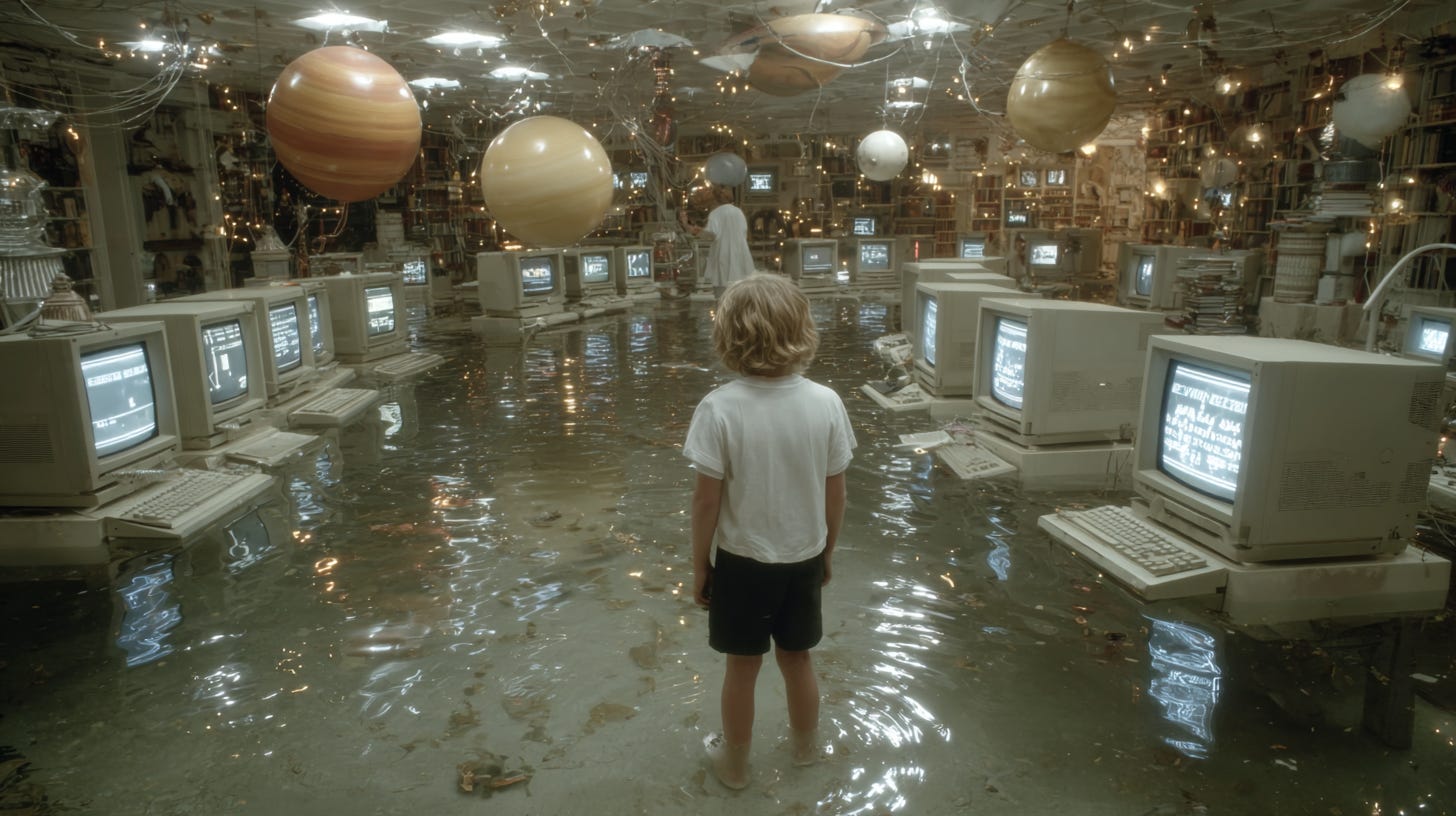
I remember walking down the hall in my elementary school, turning the corner, and entering the computer lab that lived in its own sealed-off room, separate from the rhythm of the regular classrooms. It felt like crossing a threshold. The lights were dimmer. The air was cooler. The machines hummed with a steady mechanical breath. We learned to type on Apple IIs, green letters glowing against black screens, our small hands stiff and unsure over the keys. It felt important, but not entirely safe. Adults were excited and wary at the same time. The future was arriving in plastic casings and floppy disks, and no one quite knew whether to celebrate or brace for impact.
That same year we learned about the ozone hole. Teachers pulled down maps and diagrams showing a thinning in the sky above Antarctica. The idea that the atmosphere could be damaged by our own chemicals was frightening in a quiet way. It suggested that progress left scars. It suggested that what we built could circle back and injure us. We were ten years old, and the sky suddenly seemed fragile.
And then the Challenger exploded.
We were watching in real time on a square television mounted on a metal angle-iron rolling stand at the front of the classroom. It was supposed to be triumphant. A teacher going to space. A lesson in aspiration. Instead, we watched the shuttle fracture into white smoke against a blue sky. I remember the sound leaving the room. I remember teachers’ faces shifting from excitement to something I didn’t yet have language for. Grief. Shock. Disbelief. Technology was no longer abstract. It could fail spectacularly. It could carry human lives into the sky and lose them in seconds. That moment carved itself into me in a way no lesson plan ever did.
All through college we still wrote exams longhand in blue books. The scratch of pencil on paper felt grounding, almost defiant in a world filling up with screens. Even as laptops multiplied, there was something about graphite and pressure and the ache in your wrist that signaled authenticity. Effort was visible. Time was measurable. The body was present in the work.
When Adobe Photoshop began to spread, it was used mostly by quick printers and commercial shops. Fine artists dismissed it. Digital manipulation was suspect. It was too easy. Too slick. Not real art. The assumption was that something essential would be lost if the tool replaced the hand. Over time that judgment softened. Entire generations of artists grew up fluent in digital media. The stigma dissolved because the culture adjusted its definition of mastery.
Those memories sit behind the way I hear the current conversation about AI and energy use. Data centers consume enormous electricity. Cooling systems draw freshwater. These are real, measurable pressures. At the same time, the emotional intensity around AI feels familiar. It feels like standing in that classroom watching the Challenger. Awe turning to fear in a split second. It feels like learning that the ozone layer could thin because of human ambition. Progress and vulnerability braided together.
Right now the larger atmosphere carries a similar charge. The Sun in Aquarius forms a hard angle to Uranus while traveling close to Mars. That combination describes agitation around technological systems, friction between identity and innovation, electricity in the air. Uranus in Taurus adds another layer—disruption tied to material resources, to land and water and tangible stability. Conversations about megawatts and cooling towers do not exist separately from this symbolism. They are expressions of it. The tension is not only about infrastructure; it is about what kind of world that infrastructure is building.
Saturn traveling alongside Neptune intensifies the mood. Saturn represents limits, accountability, and physical consequence. Neptune represents fear, projection, and collective imagination. When they move together, practical concerns blur with existential ones. Water use becomes a symbol of something larger. Energy consumption becomes shorthand for a question about meaning. The boundaries between measurable impact and emotional reaction thin. It is difficult to tell where fact ends and anxiety begins, because they are feeding each other.
Pluto’s long passage through Aquarius signals a deep transformation in collective systems. This is not a passing trend. It is structural change in how information, labor, and power circulate. The scale is global. The stakes feel civilizational. That is why the debate feels so charged. It is not simply about a new app or a new gadget. It is about the architecture of society.
And yet there is another influence present: Saturn in constructive dialogue with Uranus. Innovation and structure are not locked in permanent combat. There is room for redesign. There is room for smarter energy sourcing, more efficient cooling, regulatory adjustment, technological refinement. History suggests that when real limits appear, systems adapt. The ozone hole led to international agreements and chemical reformulation. The space program changed after Challenger. Risk did not end exploration; it reshaped it.
Creative anxiety threads through this as well. When AI can generate text, imagery, or music at speed, those who have built identity around those acts feel exposed. The reaction sometimes channels itself through environmental critique because environmental critique is concrete and defensible. It feels less vulnerable to say “this uses too much water” than to say “I am afraid of being replaced.” Both concerns can exist at once. One is easier to articulate.
The public mood amplifies extremes. Grand predictions circulate quickly. Some envision total automation, others total collapse. The emotional temperature rises because the symbolic weight is heavy. Technology now reaches into language itself, into art, into thought. It feels intimate. It feels personal.
We learned young that technology can wound the sky.
We also learned that we keep building anyway.
The lesson from those early memories is not blind optimism or reflexive fear. It is that transformation is rarely clean. It carries grief, adjustment, redesign, and reinvention. AI’s energy footprint deserves scrutiny. Resource management demands seriousness. At the same time, innovation will not reverse simply because it is unsettling.
The Challenger explosion taught me that progress can break your heart. The ozone hole taught me that collective action can repair damage. The Apple II taught me that what feels alien one year can feel ordinary the next.
We are inside another threshold.
Feb 11, 2026 9:37 AM PST Berkeley, CA, USA