


The first bowl I ever tried to throw collapsed in my hands.
I was fourteen. The wheel was spinning too fast because I didn’t know how to slow it down, and the clay kept buckling under my thumbs. My instructor stood behind me and said, almost casually, “You’re not centering it. You’re fighting it.”
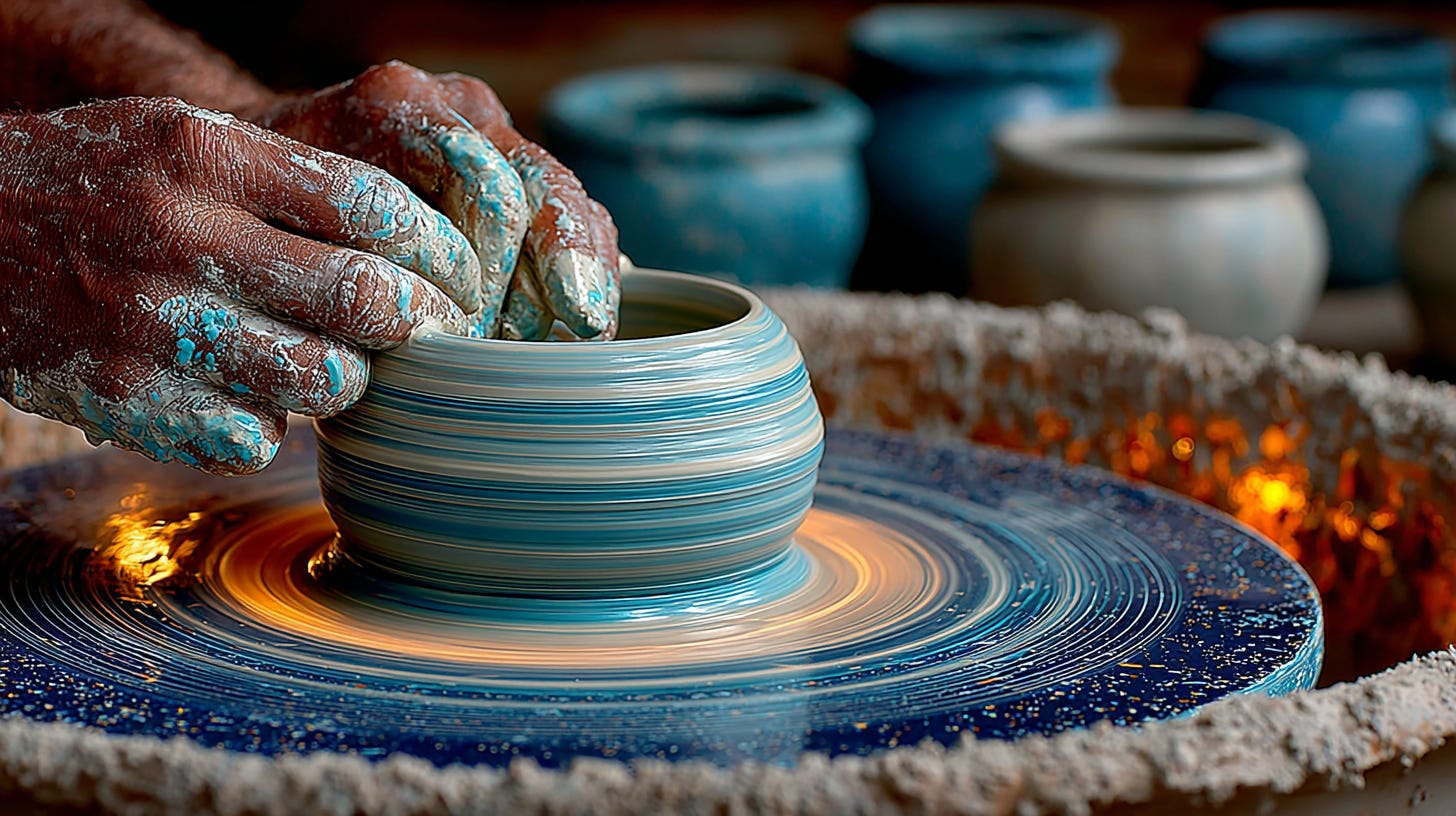
I remember feeling irritated by that. I wasn’t fighting anything. I was trying very hard. But that was exactly the problem. I was trying to shape something that wasn’t stable yet. The clay wobbled because I was wobbling. The wheel didn’t care.
It took months before I understood what centering actually meant. Not force. Not finesse. Even pressure. Both hands working against each other while the wheel spun beneath them. When the clay finally locked onto the axis, you could feel it. The wobble disappeared. The resistance softened. The same speed that had felt violent suddenly felt usable.
I think about that often when I look at how people use astrology.
For years, I used it to track events. Then to understand personality. Then to anticipate crisis. I chased good transits. I braced for difficult ones. I’ve watched others do the same — refreshing charts the way people refresh weather apps, trying to time their lives into safety. It can become exhausting. You can turn astrology into a sophisticated way of worrying.
But astrology is not the weather.
It’s the wheel.
The wheel does not stop. It does not slow down because you feel unprepared. It spins through cardinal initiations, fixed consolidations, mutable dissolutions. We call these movements past, present, future — but those are just the ways the mind organizes motion.
Cardinal energy begins. It pushes. It asserts itself. Every beginning becomes the past almost immediately. Mutable energy loosens what has begun and pulls it toward something else. It anticipates, adjusts, imagines what might come next. And fixed energy holds long enough for anything to be experienced at all.
That last part is the one we neglect.
Most people live tilted toward the future. Hope if they are optimistic. Fear if they are not. But structurally, hope and fear are twins. Both are projections. Both belong to the mutable field of possibility. One paints it gold. The other paints it dark. Either way, you are leaning forward.
And leaning forward on a spinning wheel is how you lose the form.
It took me longer than I’d like to admit to see that my own anxiety about “bad” transits was simply fear dressed up as analysis. My anticipation of “good” periods was hope disguised as strategy. In both cases, I was trying to shape the clay before it was centered. I was reacting to motion instead of finding the axis within it.
The fixed modality is not glamorous. Taurus, Leo, Scorpio, Aquarius are often described as stubborn or resistant, but that misses the point. Fixed energy is axial. It is what persists long enough to register experience. Without it, consciousness would fragment into flashes.
Sanity, at least as I’ve come to understand it, is not positivity. It is not detachment. It is axial stability. It is the ability to feel the pressure of beginnings and endings without losing the center that perceives them.
There is something in us that remains continuous through every cardinal shock and mutable transition. Childhood passes. Careers shift. Relationships form and dissolve. Bodies age. And yet awareness — the simple fact of being present — continues.
Astrology maps the changing light around that continuity. It does not replace it.
I have seen people become so identified with their charts that they forget this. They start speaking as if Saturn is doing something to them, or as if Jupiter has rescued them. But the wheel does what wheels do. Saturn structures. Jupiter expands. Mars cuts. Venus attracts. These are pressures. They are not the axis.
And when you forget that, everything feels personal.
I sometimes imagine what would have happened if my instructor had let me keep shaping that first bowl without centering it. I would have lifted the walls higher and higher until the whole thing tore itself apart. It might even have looked promising for a moment. But the imbalance would have shown eventually. It always does.
Life works the same way. You can build careers, relationships, identities on an off-center axis. You can even succeed for a while. But when pressure increases — when Saturn squares something tender, when Uranus disrupts what felt stable — the wobble becomes visible.
The point is not to stop the wheel. You can’t. The point is to recognize that the wheel spinning is not the problem. The problem is imbalance.
Sometimes the center feels almost boring. It does not trend. It does not dramatize. It does not promise salvation or predict doom. It simply holds.
And that can feel unsatisfying in a culture addicted to acceleration.
But when you have felt clay lock onto the axis under your palms, you understand the difference. The wheel can spin as fast as it wants. The form stays steady.
A few years ago, I sat back down at the wheel after a long break. My hands were rusty. The clay wobbled again. For a moment I felt that old frustration rising — the urge to force it, to muscle it into symmetry. Instead I slowed the wheel and leaned in evenly.
The wobble disappeared.
That is what I mean by continuity of consciousness. Not an abstract doctrine. A felt recognition. The spin does not have to stop for balance to return.
You don’t achieve sanity by eliminating change. You achieve it by finding the axis that remains through change.
The wheel is still spinning.
Somewhere, right now, something in your life is beginning. Something else is ending. And something is simply continuing.
The clay is moving beneath your hands.
The only question is whether you can feel the center.