


NB: I base my archetype in focus articles on the ARAS archetypes that are highlighted each month. You can find ARAS on Patreon.
Bruno Liljefors painted three sparrows in a cherry tree in 1885, and in doing so captured something that ornithology alone cannot account for. The bird in mid-flight, its thin feet extended toward a single ripe cherry, carries what the ARAS material calls “an almost human, childlike sense of expectation.” It is not simply a bird reaching for food. It is a creature suspended between appetite and restraint, between the pull of the instinct and the pause that precedes it. The cherry hangs there, succulent and isolated, and the sparrow has not yet arrived. That interval, that held breath between wanting and taking, is where the archetype lives.
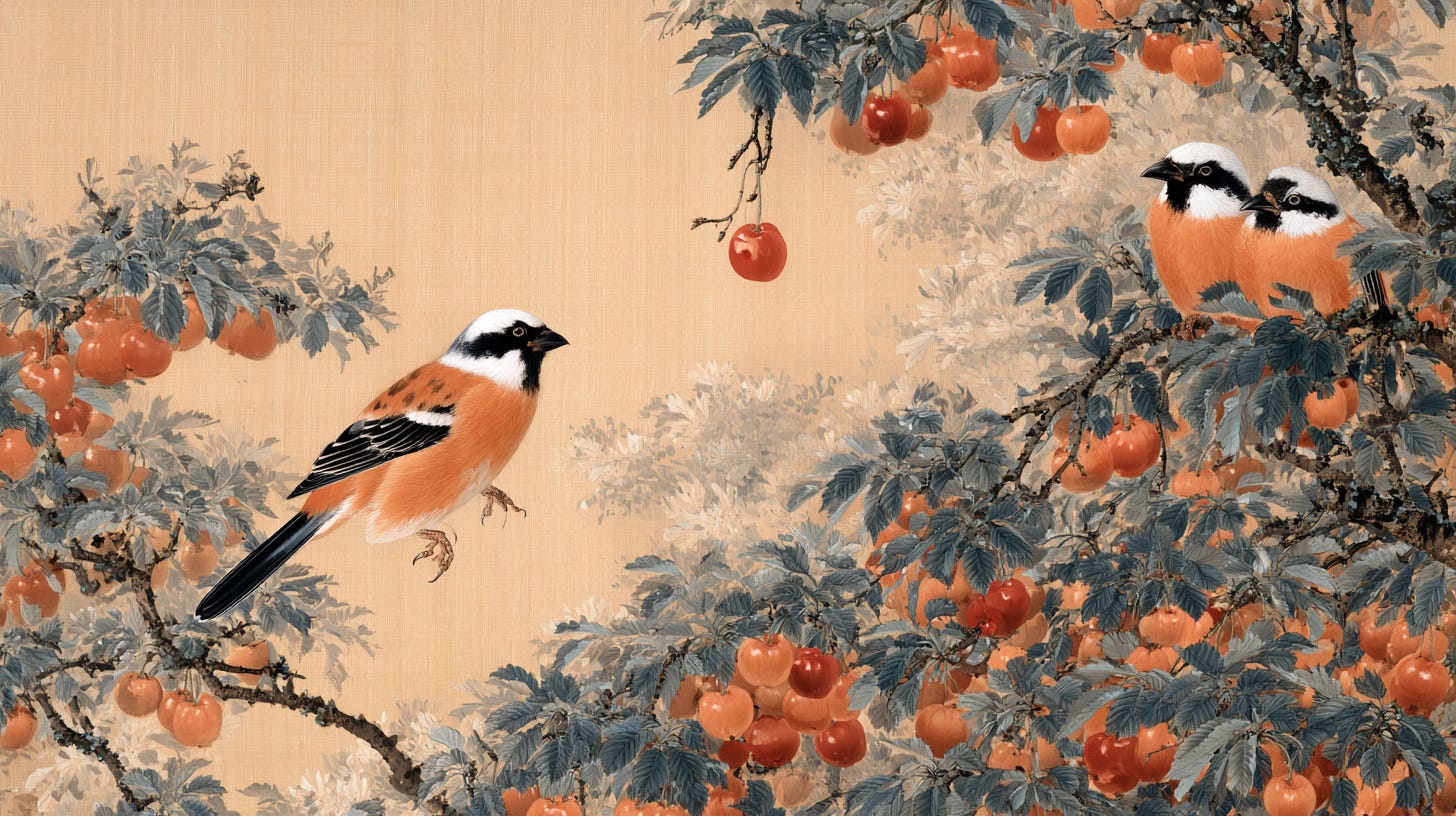
The ARAS source draws the connection directly: this image “echoes the crisis of temptation once visited upon humankind through Adam and Eve.” The sparrow at the cherry is a vernacular Eden, played out in a Scandinavian tree by a bird so common it barely registers as remarkable. This is part of what makes the sparrow such a resilient and underestimated archetypal image. It does not announce itself. It does not require a mythological pedigree or a rare sighting to carry its meaning. It arrives, as it always has, in flocks, in gutters, in the eaves of ordinary houses, and it asks its question without fanfare: what do you do with your appetite, and what does your answer say about who you are?
This essay moves through the sparrow archetype across three registers. It begins with the cultural and symbolic record, from Aphrodite’s chariot to Hokusai’s ink, from Bronze Age ritual vessels to the French naturalist who found the house sparrow “uncomfortably familiar.” It then maps the archetype onto its astrological correspondences: Venus across her dignities and phases, the 5th house’s joy, and the shadow’s natal signature in the 8th and 12th. Finally, it draws these threads together through the lens of Jungian individuation, where the sparrow’s dual symbolism, at once lecherous and humble, common and beloved, makes it precisely the kind of image the psyche needs when it is ready to stop suppressing what it has been taught to find embarrassing about itself.
Cultural and Symbolic Exploration
Common as Air
The sparrow’s most defining characteristic is its ubiquity. The ARAS material notes that because sparrows are so common, the name has become synonymous with “small bird in general.” This ordinariness is not incidental to the archetype; it is central to it. The sparrow is not the eagle, whose rarity confers automatic dignity. It is not the peacock, whose beauty commands attention. The sparrow is the bird that is simply always there, in the margins of every landscape, adapting to every condition, thriving in the gutters and the ventilation ducts and on the rooftops of the most unglamorous human environments.
Georges-Louis Leclerc de Buffon, the eighteenth-century French naturalist, found this quality distinctly irritating. His description of the European house sparrow as “uncomfortably familiar and vulgarly lively” is itself a kind of psychological document. The sparrow offends a certain sensibility precisely because it refuses to be either rare or decorative. It colonizes the nests of other birds when it finds them useful. It builds its own nests in places that are structurally sound rather than aesthetically pleasing. It propagates with unself-conscious efficiency. Buffon’s distaste is legible as the response of a classical mind to a creature that declines to perform the dignity expected of it.
This is, of course, exactly the quality that makes the sparrow a shadow image. The shadow, as Jung understood it, is not the monstrous. It is the ordinary, the embarrassing, the appetite that persists regardless of how refined one’s self-image becomes. The sparrow does not apologize for eating. It does not attempt to elevate its nest-building into something more culturally respectable. It simply continues, in its teeming millions, to do what it does. And in every era that has tried to classify it as lowly, another era has turned around and exalted it for exactly the same qualities.
Aphrodite’s Bird
The erotic dimension of the sparrow archetype has deep roots in the classical world. The ARAS source cites Athenaios, writing in the late second century CE, on the appropriateness of sparrows drawing Aphrodite’s chariot, given their lustful associations. This is not an isolated literary flourish. Sappho, centuries earlier, had already placed sparrows at the center of her most famous invocation, calling on Aphrodite to come to her “with your swift sparrows” drawing her chariot across the sky. The sparrow, for the Greek erotic imagination, was the bird of desire in its most physical, least apologetic form.
This association is rooted in observation. Sparrows mate frequently and apparently without the self-consciousness that human beings bring to the same activity. Their reproductive energy is visible, communal, and unsubtle. To the ancient naturalist and the ancient poet alike, this made the sparrow an obvious emblem of Aphrodite’s domain: not love in its idealized, courtly form, but love in its bodily urgency, its reproductive drive, its refusal to be elevated beyond what it actually is.
The ritual vessel discovered at the Bronze Age site of Thera, its sides decorated with sparrows, extends this symbolic association back to at least the late sixteenth century BCE. That a ritual vessel would carry sparrow imagery suggests the bird was already understood as belonging to a sacred register of the erotic and generative, not merely the secular or the ornamental. The sparrow on a ritual vessel is the libido honored, the body’s generative power given its proper place within the sacred order rather than pushed to its margins.
The tension the ARAS material identifies, between the sparrow as lecherous and the sparrow as humble, is not a contradiction so much as two aspects of the same energy. The body’s appetite, unacknowledged, becomes coarse and compulsive. The same appetite, acknowledged and integrated, becomes the generative ground of a life. Aphrodite does not draw a distinction between the two. Her sparrows pull the chariot regardless.
The Exalted Common Bird
Against the erotic and the vulgar runs an equally persistent counter-current: the sparrow as the emblem of divinely attended humility. The Hebrew Bible, in Psalm 84, places the sparrow at the altar of God: “Even the sparrow has found a home, and the swallow a nest for herself, where she may have her young, a place near your altar.” The sparrow’s very commonness becomes, in this register, a kind of proof of divine attention. If God attends to something as unremarkable as the sparrow, the argument runs, then nothing that exists is beneath notice.
The New Testament deepens this further. Matthew 10:29 offers the sparrow’s market value as a measure of the infinite disproportion between that price and God’s attention to each one of them. “Are you not of more value than many sparrows?” The sparrow becomes a rhetorical anchor for the argument that the divine gaze is not selective, not reserved for the impressive, not directed only toward the rare and the magnificent.
Hokusai’s print from the Great Flower series, a sparrow among hibiscus blossoms, participates in a related Japanese aesthetic tradition. In the Edo period ink and woodblock tradition, the sparrow (suzume) was a frequent companion image to seasonal flowers and grasses, its presence suggesting the animate life that persists within the natural cycle. The suzume was not elevated or idealized in these prints; it was placed within a composition with the same care given to the blossom, the stone, the branch. It was worthy of attention because it existed, not because it was exceptional.
This is the sparrow’s gift in its exalted mode: it democratizes the sacred. It refuses the hierarchy that places some creatures, some people, some forms of life above the threshold of divine concern. The sparrow at the altar is not there because it has earned its place. It is there because the altar’s jurisdiction is larger than the categories that would exclude it.
Liljefors and the Suspended Moment
The Liljefors painting functions in the ARAS material as the archetype’s defining contemporary image, and it is worth dwelling on what Liljefors actually achieves. His late nineteenth-century Scandinavian naturalism, what the ARAS source calls “sharply observed,” is not the same as photographic realism. It is a style that captures the specific quality of animal life: its unselfconsciousness, its absorption in the immediate, its freedom from the retrospective self-awareness that complicates every human moment.
The sparrow in mid-flight does not know it is making a choice. It is simply moving toward the cherry. And yet the image, in its composition, creates the sense of a pause, a held instant, in which the choice has not yet been made and all possibilities are still open. This is what the ARAS material means by “that moment of choice the psyche continually faces: the pull toward instinct balanced against the pull toward transcendence.”
The painting resonates with the Edenic echo the ARAS source identifies not because the sparrow is a moral agent weighing its options, but because we are. We look at the painting and we supply the weight of the moment. We are the ones who feel the suspended quality of the bird’s extension toward the cherry as a question about appetite and consequence. The sparrow is the occasion for our projection of the oldest human dilemma. Which makes it an extraordinarily efficient archetypal image: it does its work through our looking, not through anything it does or intends.
Astrological Framework
Venus in Taurus, Libra, and Pisces: The Body’s Three Registers
The sparrow’s dual symbolism, erotic abundance and exalted humility, maps onto Venus across her three strongest dignities: Taurus, Libra, and Pisces.
Venus in Taurus is Aphrodite’s sparrow pulling the chariot. This is Venus in her most unambiguous embodiment: sensory appetite, physical pleasure, the body’s generative abundance, the joy of food and touch and propagation taken entirely on their own terms, without apology or transcendence. The Taurean Venus does not spiritualize desire. It inhabits it. This is the sparrow mating in the eaves, building its nest in the gutter, eating the cherry without hesitation or guilt. It is the erotic life honored as a form of sacred attention to what the body already knows.
Venus in Libra shifts the register: the appetite is still present but now oriented toward relationship, toward the negotiation between self and other, toward the social and aesthetic dimensions of desire. The Libran sparrow is less the bird reaching alone for the cherry and more the pair of sparrows on the branch, the erotic life as it exists in genuine contact with another. This is Venus in her second domicile, where the generative impulse takes the form of bond and exchange rather than simple appetite.
Venus in Pisces, her exaltation, carries the sparrow into its most spiritually permeable register: the desire that dissolves the boundary between the self and what it wants, the appetite that arrives as a kind of grace rather than a drive. Pisces is the sign where the erotic and the devotional are least distinguishable from each other. The sparrow at the Psalm’s altar finds its most natural astrological home here: the common bird in the presence of the overwhelming, the desire that has moved through its own nature far enough to arrive at something that resembles surrender.
As a nocturnal planet of the Moon’s sect, Venus operates most fully in conditions of dimness and interiority rather than the broad solar light. This is entirely consistent with the sparrow archetype: both the erotic dimension and the humble dimension of the sparrow’s symbolism are most visible in the margins, in the half-light, in the spaces that daylight consciousness tends to overlook. Venus’s sect affiliation tells us that her intelligence is closer to instinct than to reason, closer to the Moon’s tidal knowing than to the Sun’s declarative clarity. She finds the cherry by feel, not by calculation.
Venus’s joy in the 5th house is the archetype’s most direct astrological home: the house of creative expression, pleasure, children, and the body’s delight in its own capacities. The 5th is where the sparrow on the Thera ritual vessel lives before the moral split between the lustful and the humble has been imposed. It is the generative life-force in its undivided form, the appetite that has not yet been pushed into the shadow because it has not yet been told it needs to be.
The morning and evening star phases add a final layer to the sparrow’s dual symbolism. Venus as morning star, Lucifer, rises before the Sun: her desire is outward-facing, assertive, visible, leading rather than following. This is the sparrow in mid-flight, the appetite that reaches openly for what it wants. Venus as evening star, Hesperus, sets after the Sun into the gathering dark: her desire turns inward, reflective, more private and deliberate. This is the sparrow at the altar, the appetite that has learned to sit quietly with what it wants rather than immediately moving toward it. Both phases are genuinely Venusian. The sparrow that understands both is the one that has integrated its own nature most completely.
The 6th House: The Sparrow’s Daily Round
In whole-sign astrology, the 6th house governs daily routine, service, craft, and the body’s maintenance: the repetitive, unglamorous work that sustains life. It is not a house that announces itself. It is the house of the sparrow: present in every day, adaptive, industrious, unglamorous in its operations, indispensable in its function.
Planets placed in the 6th house often carry a quality of the shadow’s ordinary face. Their energy is not hidden in the dramatic sense of the 8th or 12th; it is hidden in the sense of being so constant, so woven into the texture of daily life, that it goes unnoticed. The 6th house planet works the way the sparrow works: in the margins, in the gutters, in the eaves, tending the life that the more visible planets inhabit.
The 6th house also governs what was traditionally called “small animals,” the sparrow’s domain in the most literal sense. But more significantly, it governs the relationship between the self and its own instinctual nature: the habits, the appetites, the bodily rhythms that persist regardless of what the higher faculties prefer to believe about themselves. This is the shadow’s ordinary face. The 6th house is where the Buffon-like part of the psyche encounters the parts of itself it finds “uncomfortably familiar and vulgarly lively,” and must decide what to do with them.
The 8th and 12th Houses: The Shadow’s Natal Signature
If the sparrow’s humble and serviceable face belongs to the 6th house, its shadow dimension, the erotic, the repressed appetite, the thing that reaches for the cherry, belongs to the 8th and 12th.
The 8th house governs shared resources, transformation, and what is hidden beneath the surface of a life. It is the house of the body’s depths, the inherited patterns and desires that operate below the level of conscious choice. Planets here carry something of the sparrow’s suspended moment: the energy that exists in that held instant before the appetite is acknowledged, before the choice is made. The 8th house planet wants the cherry. The question is whether that wanting is suppressed, which gives it more force rather than less, or integrated into a conscious relationship with the body’s actual nature.
The 12th house adds a further dimension: the shadow in its most sequestered form, the energy that has been not merely suppressed but exiled from conscious life entirely. Planets in the 12th carry the quality of the sparrow behind the wall, the desire that has been placed so far outside the territory of acceptable selfhood that the person barely recognizes it as their own. The 12th house sparrow tends to emerge sideways, through compulsion or projection, precisely because it has never been acknowledged at the altar where even the sparrow has found a home.
The Moon: Appetite, Instinct, and the Tidal Pull
The Moon is the astrological body most resonant with the sparrow’s relationship to instinct. In Hellenistic whole-sign astrology, the Moon governs the body’s rhythmic life, the ebb and flow of appetite, mood, and need. She is not selective about which instincts she governs: the hunger for food, the hunger for contact, the hunger for warmth, the hunger for belonging. She attends to all of them with the same democratic care that the Psalm gives the sparrow at the altar.
As the luminary of Venus’s sect, the Moon and Venus share a fundamental orientation toward the nocturnal, the instinctual, the interior. Where the Sun and Mars operate by direct assertion and solar clarity, the Moon and Venus know by feel, by rhythm, by the quality of the available light. The sparrow that navigates by this lunar intelligence is the one that finds its nest not by survey but by returning, again and again, to what already feels like home.
The Moon’s phase at birth carries particular relevance for how a person relates to their instinctual nature. The Full Moon native tends to experience the tidal pull of instinct as visible, even public, difficult to contain within private life. The New Moon native may find that their hungers are less available to conscious inspection, operating in the dark of the lunar cycle, closer to the 12th house sparrow than to the one in mid-flight. The Balsamic Moon native carries the appetite of a completed cycle, the desire that has been through many iterations and arrived at something close to wisdom about its own nature.
In every case, the Moon’s relationship to the sparrow archetype is fundamentally about acknowledgment. The Moon does not judge the appetite she governs; she simply reflects it. The task for the native is to develop the same non-judgmental attention to their own instinctual life that the Moon brings to the tides.
Cross-Cultural and Astrological Integration
The Shadow’s Feathered Face
The ARAS material’s most direct interpretive move is to identify the sparrow with Jung’s shadow: “the sparrow’s dual symbolism, at once lecherous and humble, common and beloved, makes it a fitting emblem for the shadow.” Jung argued that psychic wholeness depends not on suppressing the shadow but on reconciling it with consciousness. The sparrow models exactly this tension.
The shadow, in Jungian terms, is not simply the negative or the dark. It is whatever has been excluded from the ego’s preferred self-image. For a culture that prizes spiritual refinement, the shadow tends to include the body’s appetite. For a culture that prizes productivity and efficiency, it tends to include the capacity for rest and pleasure. For an individual who has built an identity around intellectual achievement, the shadow often carries exactly what Buffon found distasteful in the sparrow: the vulgarly lively, the uncomfortably familiar, the instinct that persists regardless of how elevated the self-concept becomes.
Integrating the shadow is not the same as acting out every suppressed appetite. The sparrow in Liljefors’s painting is still suspended in its moment of choice. The point is not that the bird should always take the cherry; the point is that the reaching itself, the honest acknowledgment of the wanting, is more healthy than the pretense that the cherry isn’t there. A person who has integrated their sparrow shadow is not more indulgent than before. They are more honest. The energy that was going into suppression becomes available for actual choice.
Astrologically, this integration tends to coincide with transits and progressions that activate the 8th and 12th houses, or that bring the shadow planets into conjunction with the personal points. These are the moments when the sparrow behind the wall insists on being seen: when the appetite that has been coded as shameful pushes back into consciousness and demands its place at the altar.
The Ritual Vessel and the Sacred Appetite
The Bronze Age ritual vessel from Thera, its sides decorated with sparrows, places the bird within a sacred context that predates the moral categorizations that came later. The sparrow on a ritual vessel is not yet divided into the lustful and the humble. It is simply present within the sacred container, part of the symbolic vocabulary available to a culture for articulating its relationship to the generative powers of life.
This suggests that the sparrow’s dual symbolism, the split between the Aphroditic and the Psalm’s version, may be a relatively late development in its archetypal history. Before the split, the sparrow may have been simply a bird of life-force, of the generative energy that propagates and flourishes and builds its nests in whatever structure offers support. The ritual vessel honors this generative energy directly, without the subsequent need to divide it into acceptable and unacceptable forms.
Astrologically, the 5th house, Venus’s joy, carries something of this pre-split sparrow energy. The 5th house is where the erotic dimension and the Moon’s appetite for delight converge in a register that has not yet been sorted into the shadow. Planets in the 5th often carry a quality of the sparrow on the Thera vessel: the generative life-force in its undivided form, available for creative expression precisely because it has not been pushed into the 12th.
Hokusai’s Line and the Sparrow’s Sufficiency
The Japanese tradition of the sparrow-and-flower print, exemplified by Hokusai’s sparrow among hibiscus blossoms, offers a final integration that neither the erotic nor the humble Western readings quite reach. In the Zen-influenced aesthetics of Edo period Japan, the sparrow’s value was not contingent on what it symbolized or what moral lesson it could be made to teach. The sparrow was simply the sparrow, worthy of a master’s attention because it existed, because it was alive in the present moment, because its small precise body in a precise composition with a hibiscus blossom was complete in itself.
This is the sparrow at its most integrated: not as emblem of anything, not as shadow or as saint, but as a living being fully inhabiting its own nature. The Zen tradition would call this quality suchness, the radical ordinariness of a thing that is entirely what it is. The sparrow in Hokusai’s print is not reaching for the cherry or refraining from the cherry. It is present with the hibiscus, which is to say it is present with what is actually there.
This offers an astrological correlate in Venus as evening star: not straining toward assertion, not pushing outward into the light, but settled into the gathering dark with whatever is genuinely wanted. The Venus that has integrated the sparrow’s lesson is not less desirous than before; it is more accurately desirous, wanting what it actually wants rather than what it has been told it should want, and finding in that honesty a sufficiency that no amount of suppression ever achieved.
Negotiation with self nature
The sparrow endures as an archetypal image because it refuses to be tidied into a single meaning. It is Aphrodite’s bird and the Psalm’s bird, the creature Buffon despised and the creature Hokusai honored with the same care he gave the hibiscus blossom. It is the ritual vessel and the ventilation duct, the erotic abundance and the humble service, the bird suspended between flight and appetite in a Scandinavian cherry tree in 1885.
The ARAS material identifies this refusal as the sparrow’s most significant psychological function: to model “the self’s ongoing negotiation with its own nature.” The negotiation is not resolved by choosing one face of the sparrow over the other. It is not resolved by deciding that appetite is always wrong or always right, that the common is always base or always sacred. It is carried forward, as the sparrow carries itself, by continuing to show up in the margins of every landscape, adapting to every condition, building the nest in whatever structure offers genuine support.
Astrologically, the sparrow’s lesson arrives through the Venus cycles that return us to the question of what we actually want and whether we can bear to acknowledge it honestly, through the Moon’s democratic attention to every appetite without exception, through the morning star’s willingness to lead with desire and the evening star’s willingness to turn inward with it. These are the moments when Liljefors’s bird extends its feet toward the cherry, and the image asks its question again: what do you do with your appetite, and what does your answer say about who you are?
The sparrow does not wait for the answer. It is already in flight, thin feet extended, expectation intact, moving toward the single succulent cherry with the full commitment of a creature that has never learned to be ashamed of wanting what it wants. That is not the whole of what the archetype teaches. But it is where the teaching begins.