


Previously: Art, Craft, and the Question With No Final Answer.
I remember sitting in a classroom at UH Mānoa — BFA, somewhere in the late 1990s — when a professor walked us through a project that I haven’t been able to stop thinking about since. I want to be careful about how I tell this story. What follows is what I was taught, filtered through memory that’s now more than two decades old. I haven’t been able to locate a published account of the specific episode, and I’m working from recollection, not documentation. But the idea is clean enough, and instructive enough, that it deserves to be thought through carefully even at the risk of imperfect attribution — which is itself part of the point.
Here is what I remember.
Two instructors — Andrea Feeser and Gaye Chan — were making embroidery together. Real embroidery. Hand-stitched, skillfully executed, the kind of thing that takes patience and a steady hand and actual hours. This was not machine-printed fabric dressed up to look handmade. It was the genuine article.
And then they put it on eBay.
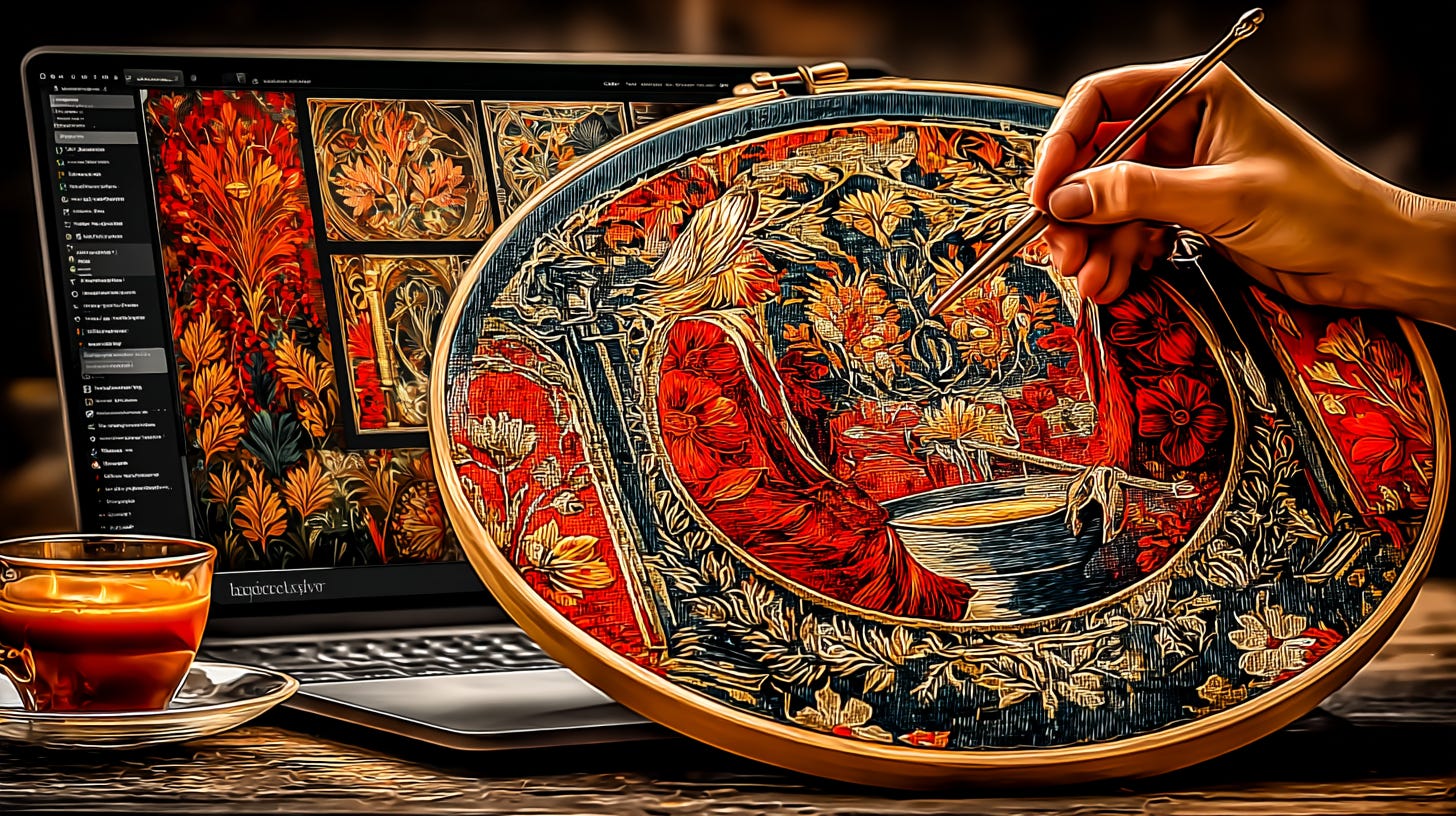
This was early eBay, which matters. The internet was still young enough to feel like a frontier. People were just beginning to trust it with their money. The platform was mostly used and idiosyncratic objects — things with history, things that needed a story to make sense of why they existed and why you might want them. The platform ran on narrative almost as much as it ran on search queries.
So the two instructors created a persona. A fictional woman. They gave her a backstory — specific, emotionally resonant, the kind of story that makes you lean in and keep reading. They listed the embroidery pieces under her name, wrote item descriptions from her perspective, and when buyers sent questions, they answered in character. The persona wasn’t a sketch. It was a fully inhabited fiction, deployed through the mechanics of a commercial marketplace.
The pieces attracted buyers. They bid. Some of them bid seriously.
And then, when a buyer won an auction — before payment, before the transaction completed — the instructors broke frame. They wrote to the winning bidder and disclosed what was happening: this was an educational art project, the persona was fictional, the backstory was invented. You don’t have to go through with this. You can walk away.
Most of the buyers did not walk away.
And this, as I understood it from that classroom, was the lesson.
Walter Benjamin wrote about aura — the quality that makes an original work of art feel different from a reproduction of it. He tied it to presence in time and space, to the sense that an object has a history, that it has existed somewhere specific and traveled to reach you. A Rembrandt has aura not just because it’s skillfully painted but because it is that Rembrandt, the one that has been in a specific place and time and has accrued the gravity of its own existence. A perfect reproduction, no matter how technically identical, doesn’t carry the same weight.
Benjamin was writing in 1935, worrying about photography and film. He thought mechanical reproduction would erode aura. What the embroidery experiment suggested, to me, is that he was only half right.
The physical stitches on those pieces of cloth were craft. Real labor, genuine skill, the kind of handwork that carries its own meaning simply by virtue of how much time it required. Nobody faked the thread.
But why were buyers bidding? What made those specific pieces more compelling than other embroidery listed that same week?
It was the story. The persona. The invented biography of a woman who had made these things, whose life gave the objects their particular gravity.
And here is the part that Benjamin’s 1935 framework would struggle to account for: when the fiction was disclosed, the aura didn’t disappear. It shifted. Before the reveal, the buyer was purchasing a craft object plus a story that felt true. After the reveal, the buyer was purchasing a craft object plus the knowledge that they had just been a participant in a live performance about value, authenticity, and how we decide what things are worth. The story had been fictional but the experience of being drawn in, the experience of caring about an object because of its supposed history — that was entirely real.
The aura migrated from the maker’s invented biography to the buyer’s actual encounter with the work.
I think about this a lot when people talk about AI-generated content and whether it can ever carry authentic meaning.
The embroidery experiment wasn’t a lesson about deception. It was a lesson about where value lives. The instructors weren’t trying to swindle anyone — they disclosed before money changed hands, they offered a clean exit. What they were demonstrating was that craft and aura are separate things, that one can exist without the other, and that the relationship between them isn’t fixed.
The embroidery had craft. Physically real, skillfully made, the product of hours of embodied human work. But the craft alone didn’t explain why people wanted it over other equally well-made pieces on the same platform.
The aura came from somewhere else — from the fiction, from the narrative that surrounded the object and gave buyers a reason to care. And when the fiction was stripped away, the buyers had a choice: walk away, or lean into the new layer of meaning that had just been revealed. Most leaned in.
I’ve sometimes described this to people using the conceit from Westworld — the idea that meaning exists in layers, and that going deeper into a layer doesn’t destroy the meaning that came before, it transforms it. The buyers who stayed weren’t insisting the original story was true. They were choosing to participate in what had replaced it. They were buying their own moment of recognition.
Now here is where I want to be careful about overclaiming, because the archival record on this specific project is thin. Feeser and Chan co-founded DownWind Productions at UH Mānoa — I think around 1998, though I’m not certain of the exact date — and made e-commerce and commodity form central to their conceptual and pedagogical work. The exact episode I’m describing — hand-stitched embroidery, the fabricated seller persona, the pre-payment disclosure, the buyers who completed the purchase anyway — that’s how I remember it. Memory, not record.
There are better-documented parallels that point in the same direction. A few years after the period I’m describing, Rob Walker and Joshua Glenn conducted the Significant Objects project — I think it ran 2009 to 2012 — purchasing thrift-store objects for an average of roughly $1.25 and reselling them on eBay with fictional stories attached, netting more than $3,600 in the first phase. That demonstrated systematically and at scale that narrative attached to ordinary objects dramatically increased the prices buyers were willing to pay. The UH Mānoa project I remember had a different ethical structure — the deception was temporary and disclosed — but it was asking the same underlying question: does the story live in the object or in the telling?
Around the same time, Mendi and Keith Obadike created Blackness for Sale — around 2001, if I’m remembering right — which used eBay as performance space for a different kind of critique. Keith listed his “Blackness” as an auction item, raising questions about the commodification of identity before eBay removed the listing. The platform, structurally, invited this. eBay ran on trust and story. It was a machine for generating aura around used things.
What the instructors at UH Mānoa were teaching, in a class on early internet art and conceptual practice — I don’t remember the course number — was something I didn’t fully understand the implications of until I started working alongside generative AI systems.
The embroidery was craft. The aura was something else — constructed, layered, ultimately transferable to the buyer’s own moment of understanding.
This isn’t an argument that deception is fine as long as you disclose it eventually. The embroidery experiment worked precisely because disclosure happened before money changed hands, because the buyers were offered a real choice. What it demonstrated was that meaning is more mobile than we tend to assume. It doesn’t live exclusively in the object. It doesn’t live exclusively in the maker’s biography. It lives in the encounter — in what a person brings to an object and what they take away.
A ceramic pot made by a student who just finished their first semester is not less real than one made by a master. The clay is the same clay, more or less; the glaze probably isn’t that different. What the master has is a longer conversation between their hands and the form — a history of choices and failures and the occasional inexplicable success that shaped how this particular pot came to exist. That history is legible, at least to some viewers. That’s what gives the master’s work its weight.
Craft is what’s on the cloth. Aura is harder to name than that — it’s what makes you lean toward one piece over another without quite being able to say why, and then, when pressed, realize the answer has something to do with where the thing came from and who you are now that you’ve seen it.
I’m going to argue, in the posts that follow this one, that almost all the controversy about AI-generated content is a confusion between these two categories. The craft argument (is the output technically good?) and the aura argument (does this thing carry meaning, does it come from somewhere, does it go somewhere?) are separate questions that get collapsed together constantly.
The instructors at UH Mānoa — whoever they were exactly, however imperfectly I remember the details — were working on the aura question before the craft question even arose. The embroidery was already good. The question was: what do we mean when we say it matters?
The buyers who stayed after the reveal had an answer. They had participated in something. The object was now a token of their own experience. That experience was real, regardless of the fiction that had produced it.