


A reader wrote in this week to point out something that surprises a lot of people when they first notice it. Vesak — the full moon on which Buddhist tradition holds the Buddha was born, awakened, and entered parinirvana — is not on the same day across Buddhist traditions. In the Nyingma calendar, Saga Dawa (the Tibetan name for the Vesak month) began on May 17, 2026, and culminates on the full moon of May 31. In the Theravāda traditions of Southeast Asia, the same observance landed weeks earlier. The Sri Lankan, Thai, and Burmese sanghas are not making a mistake. Neither are the Tibetans. They are reading the same sky through different anchoring systems, and the difference is built into how lunar calendars have to work.
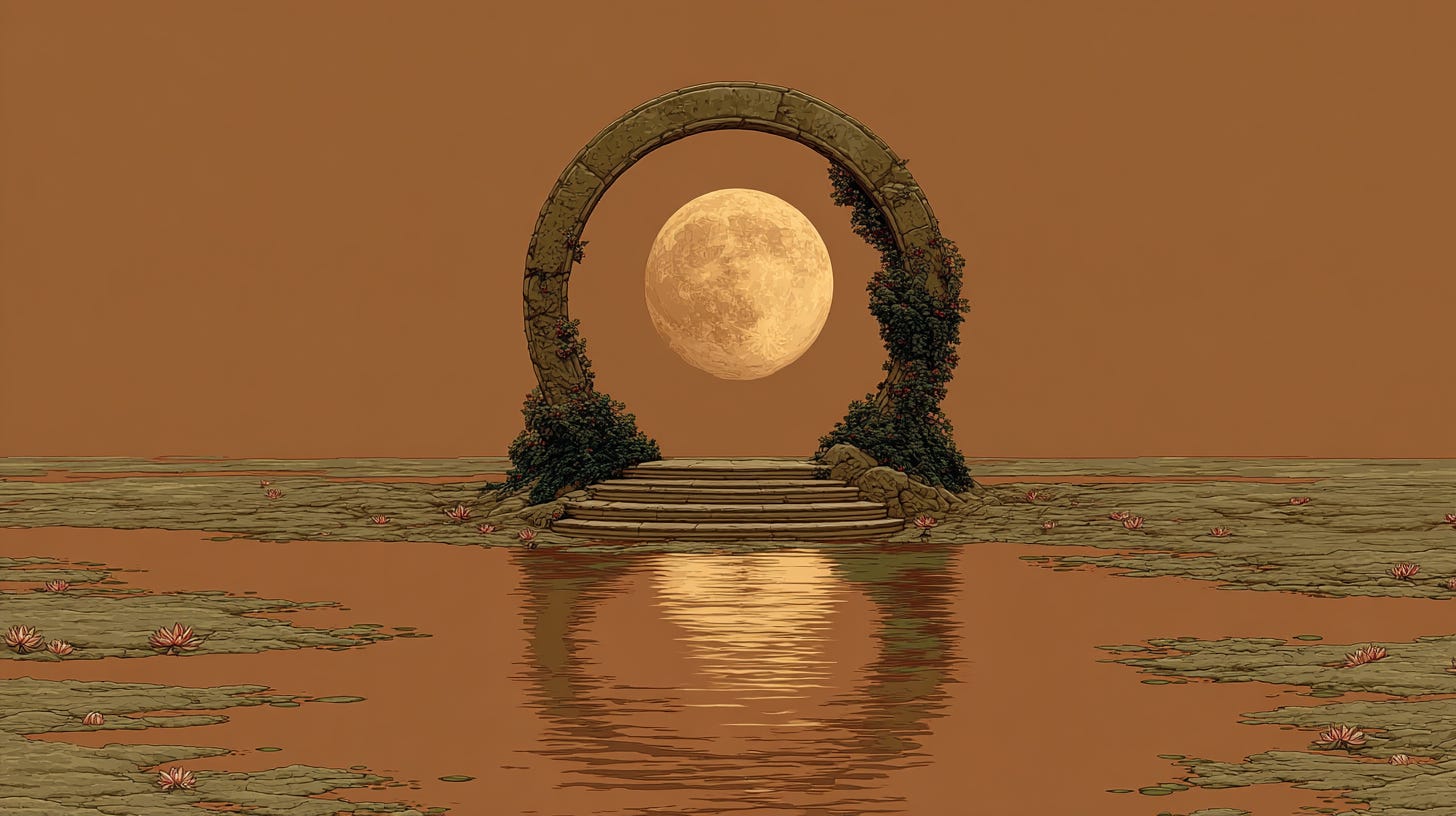
I want to walk through what’s actually happening, because once you see it, you also see something about the configuration itself — about why this particular full moon, in this particular stretch of zodiac, has been the one carrying the weight of the Buddha story for two and a half millennia.
The problem the calendar is trying to solve
A lunar month is about 29.5 days. A solar year is about 365.25 days. They do not divide evenly. Twelve lunar months come up about eleven days short of a solar year, which is why purely lunar calendars (like the Islamic calendar) drift through the seasons. Most Buddhist calendars are luni-solar — they want lunar months, because the Moon is the bright clock in the night sky, but they also want the months to stay roughly anchored to the seasons. To pull that off, they intercalate. Periodically they add a thirteenth month to bring the count back into line with the Sun.
That works, but it leaves a question: where does the year start? You have to pick an anchor point. Most systems anchor somewhere after the winter solstice, but different traditions choose different anchors. Chinese new year is the second new moon after the winter solstice. Tibetan Losar is, in the Phugpa tradition, the new moon nearest the start of the lunar fourth month from the previous year’s winter solstice. Thai Songkran is solar, fixed in mid-April. Each system has its own logic, and each logic produces a slightly different starting count.
Once you have a starting point, you count months from there. Vesak is named for a numbered month — the second month in some traditions, the fourth in others, the sixth in still others, depending on how the year is structured. And here is where it gets clean: the celebration is not pegged to the zodiac sign directly. It is pegged to the count. Whichever full moon falls in that numbered month is Vesak.
This means the full moon can land in Libra, in Scorpio, or even brushing into Sagittarius, depending on the year and the system. The fluctuation isn’t sloppy. It is the necessary consequence of asking a lunar count to live inside a solar year.
The actual sky underneath the celebration
If you go behind the calendar and just ask the sky what is happening, you get a more specific answer. The full moon being honored as Vesak is the full moon that falls in a particular stretch of the lunar ecliptic — the Vedic nakshatra called Viśākhā (Vesak is the Pāli form of the name), which runs from roughly 20° Libra to about 3°20’ Scorpio. Anurādhā follows it, taking us deeper into Scorpio. So when we say “the Vesak full moon,” what we are actually pointing at is a Moon at full opposition to the Sun, with the Moon sitting in the Libra-to-Scorpio handoff zone of the zodiac.
This zone has another name in the Hellenistic literature. It is called the Via Combusta, the burnt road. The traditional definition gives it the same boundaries — about 15° Libra to 15° Scorpio, give or take a few degrees depending on the source — and the traditional reading is grim. The Via Combusta is the stretch where the Moon is considered weakened, where horary charts with the Moon in this region were thrown out by William Lilly and the medieval astrologers as unreliable, and where, at 3° Scorpio specifically, the Moon hits her exact place of fall — her tapeinōma, the locus of her greatest debility in the dignity scheme.
So we have a paradox sitting right on top of itself. The Hellenistic tradition reads this stretch of sky as the Moon at her worst. The Vedic tradition reads the same stretch as Viśākhā, the triumphal arch, and as Anurādhā, the lotus blooming from the mud. Buddhist tradition picks this exact lunation to honor the awakening of the Buddha. Three traditions, one configuration, and the readings appear to be flatly opposed.
What I came to about that contradiction
I have been sitting with this for the better part of a month, because I made a series about this full moon — eight videos, a 177-page companion PDF — and the contradiction is the structural problem the whole project is trying to address. I’ll tell you here what I told the readers there. Both readings are correct. They are not describing different things. They are describing the same operation from opposite ends.
The Hellenistic fall is the descent. The Vedic arch is the attainment of that descent. The mud is what allows the lotus. The Moon, brought to her place of trial, is the Moon at work. The burnt road and the triumphal arch are the same road, named once for what it costs and once for what it produces. The Buddhist tradition, choosing this lunation to mark awakening, is making a third-position statement that absorbs both: that the awakening happens precisely where the moon is most undone, and that the undoing is part of the structure, not an interruption of it.
This is why the calendar variation matters less than it might seem to matter. Whether your tradition lands the celebration on the Libra side of the corridor or the Scorpio side, you are still inside the same nakshatra-pair, still inside the same Via Combusta, still inside the same operation. The calendars disagree on which full moon to honor. The sky is having one long conversation across that whole stretch.
A practical takeaway
If you are reading this and you keep a lunar practice — Buddhist or otherwise — the thing worth noticing is that you do not have to pick a tradition’s date to participate in what the configuration is doing. The window is wider than any one calendar makes it. The Moon walks through Viśākhā and Anurādhā in roughly five or six days, and the full opposition to the Sun lands somewhere inside that window every year. If you mark the Theravāda Vesak in early May and your Tibetan friends mark Saga Dawa Düchen at the end of May, you are not on different holidays. You are on different doors into the same room.
For anyone wanting to go further on this, I wrote about the descent specifically in The Fall Is the Gateway here on findyournova, and the full multi-tradition reading is the series I mentioned above, The Sovereign Sacrifice, which is available as a pay-what-you-can download.
The Moon will do this again next year. Different date. Same road.